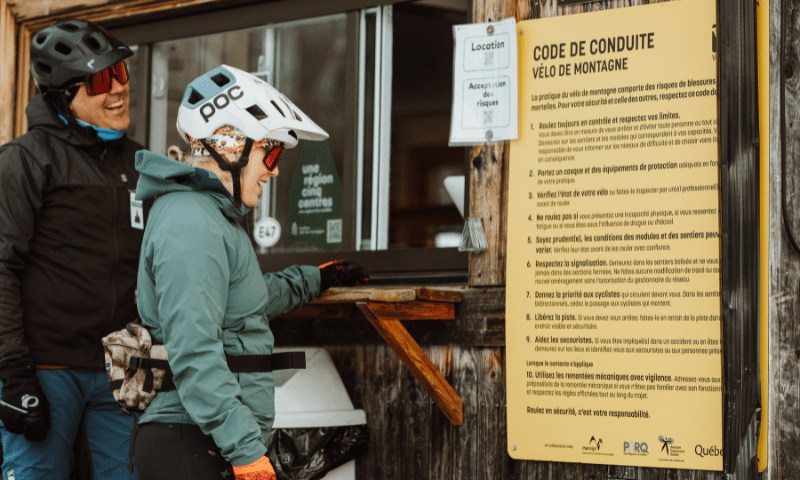


Smart mountain biking
«Riding intelligently» means analysing and practising before taking the plunge. Mountain biking is exhilarating, and to keep it that way, slowing down before accelerating is always a good idea.
This simple approach to mountain biking reduces risks, protects trails and maximizes enjoyment. Observing the terrain, practicing and anticipating obstacles not only helps to avoid injuries and falls, but also allows you to ride with respect for the environment and other people.
Whether it's your first run or not, the trails change with the weather, and your riding will vary according to your energy at the time. The unexpected can happen at any time. By gradually adapting your riding and being aware of your energy level as the day progresses, you maximize safety and fun for everyone on the trails.

Analyze. Practice. Roll.
1- Analyze (pre-ride)
- Preparing body and mind.
- Drive slowly to observe the track.
- Identify technical sections, slope and surface changes, and visualize the best trajectories.
- Check the condition and operation of your equipment.
2- Practice (re-ride)
- Work on one technique at a time (eye contact, position, braking, pumping, jumps).
- Repeat key sections several times to reinforce muscle memory.
- Gradually adjust tempo and trajectory until comfortable.
3- Rolling (free-ride)
- Accelerate gradually, while remaining comfortable, fluid and constant at every step.
- Increase the length and difficulty of routes without skipping stages.
- Keep pleasure at the heart of the experience, while remaining within the control zone.
Key principles for safe progress
Getting to know the trail
Identify difficulty, technical sections, weather and ground conditions in order to adapt your speed and choice of lines to your abilities.
Practice before you try
Tight hairpin bends, rock fields, roots, small breaks: practice first on similar terrain, an open area, a park, a wide, safe path to consolidate your technique and confidence in negotiating the technical elements that pepper our trails.
Progressiveness
Don't try to do everything too quickly. Start with easier portions, then gradually increase the complexity. Gradual progression builds both technical skills and mental resilience.
Equipment safety
A bike in good condition, well-tuned brakes, suitable tires in good condition, and body protection appropriate to your riding style and comfort level. By using reliable equipment, there's less risk of injury and better control of the unexpected. More fun guaranteed!
Respect for the trail and others
Staying on marked trails, giving way in accordance with the mountain bike code of conduct, slowing down in busy areas and not altering the trail layout are all ways of helping to preserve access to and the quality of the trail network. Thank you for your support!
Progress intelligently on your mountain bike!
Analyze, practice and ride to transform apprehension into confidence and enjoy every outing in complete safety.
Riding intelligently means learning to enjoy every passage, every obstacle, every descent... in complete safety.
Progressing on an electric mountain bike
An electric-assist mountain bike is heavier and handles differently from a muscle bike. Make sure you've mastered the basic techniques of mountain biking, so you can stay in control at all times and stop when you need to.