
Learning and progressing on a mountain bike
Mountain biking is characterized by the diversity of its trails: natural surfaces, roots, rocks, steep slopes, rolling or technical sections.
Each section of the course requires you to adjust your pace, your position and your gaze. On the trail, overcoming obstacles and controlling the bike in technical sections are both a major challenge... and a great source of pleasure!
The first instinct is often to tense up and try to control everything. But you need to learn to do the opposite: let the bike move without constraining it. The terrain is never flat or predictable, and that's exactly what makes riding so stimulating!
Mountain biking is a dance between the rider, the bike and the trail.
Every obstacle, every root, every bump requires a little adaptation, special attention and a little confidence.
Here are the main cycling skills required for mountain biking:
Finding the right position
The first skill to be developed is body stability.
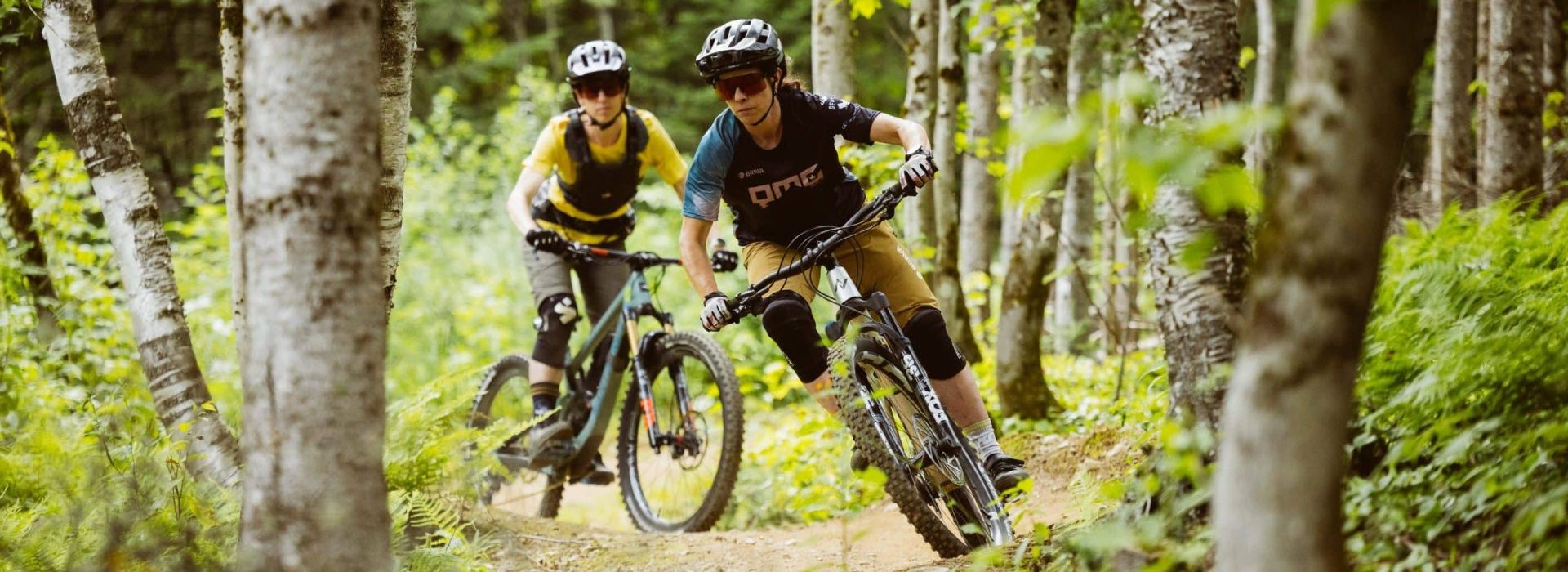
- Keep your body relaxed, with knees and elbows slightly bent helps to absorb ground irregularities without becoming unbalanced.
- Visit weight must be centered on the bike, The rear wheel is not too far forward, nor too far back, to maintain good grip on both wheels.
- The look carried forward, a few metres in front of the bike, constantly scanning the route ahead. In mountain biking, the bike follows your gaze, so you might as well set your sights on the goal to be reached rather than the root to be avoided!
Managing ascents and descents
Climbing is all about pace and traction.
- Maintaining a seated position for as long as possible promotes traction on the ground.
- A smooth pedaling prevents the wheels from spinning.
- When the slope straightens out, bringing your chest slightly forward towards the handlebars helps stabilize the front wheel without losing leg power.
On the descent, the approach changes completely: you need to relax.
- Lower the body slightly and let the bike move as freely as possible. Arms and legs become natural suspension.
- The aim is not to avoid every stone, but rather to’follow the bike's movements to maintain control, even when the going gets rough.
Mastering braking
When descending, the key is to control your speed so that you're always in a position to stop if necessary. Braking is a subtle art. It's all about modulating your speed to stay fluid.
- Front and rear brakes work together: the front brake controls speed, the rear brake prevents acceleration.
- Always manage your speed before obstacles, And above all, do it gradually: gentle braking is better than panic.
Read the pitch
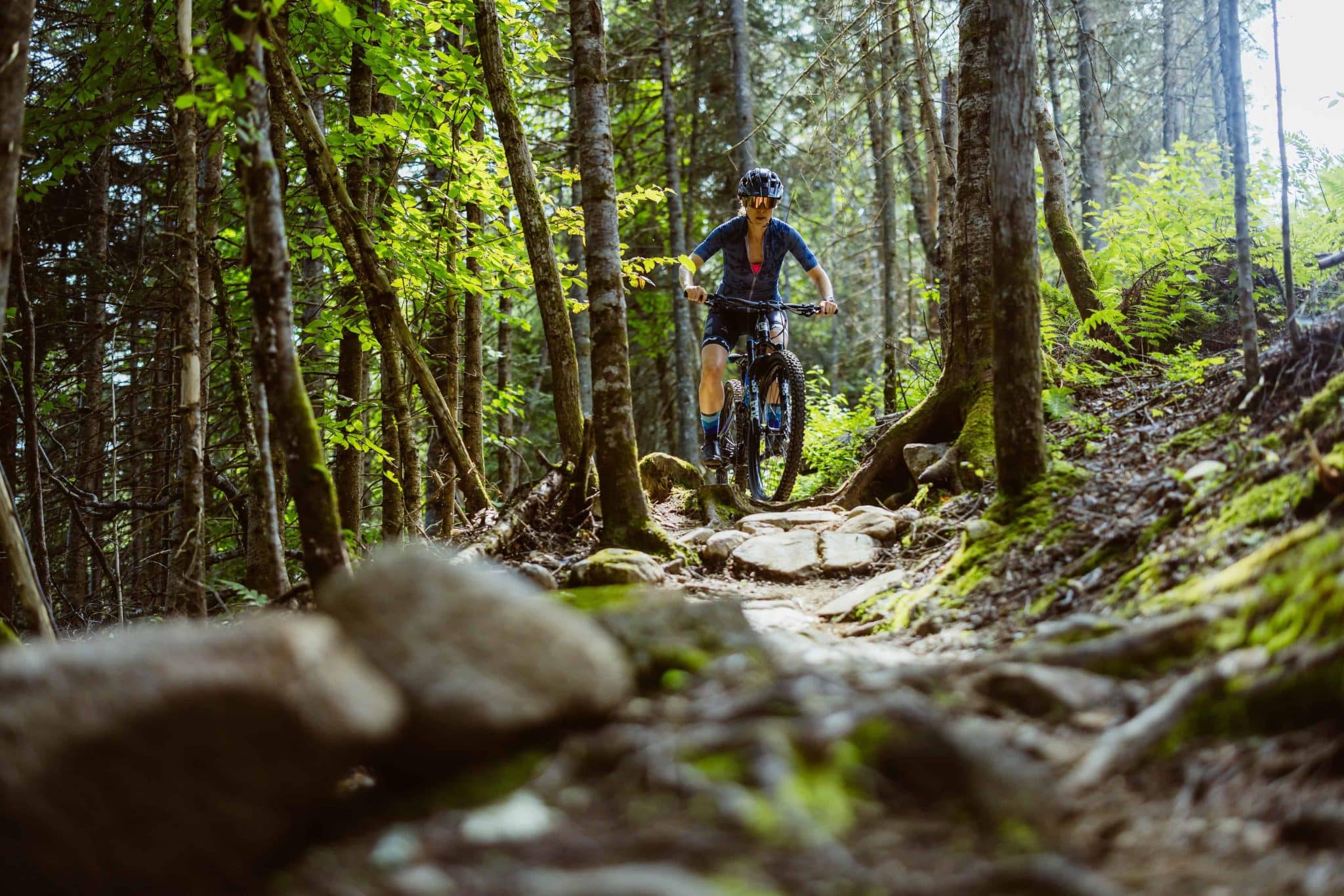
Knowing how to «read» the trail means anticipating what's coming. It means noticing a slippery root, a deep rut, a rolling rock and choosing the smoothest line to cross it in control.
This ability to anticipate comes with experience. The miles that accumulate are opportunities to learn to recognize surfaces, to feel tire traction, to adjust your weight or speed at the right moment. Taking the time to look out for unknown obstacles is a good habit to adopt, whatever your experience.
All these skills - position, eye contact, braking, reading the terrain - develop with time and practice. In the beginning, mistakes are part of the game. Losing your balance, braking too late, freezing in a bend are all part of progress... Then, outing after outing, everyone finds their own rhythm.
Trail riding means learning to trust your bike and yourself. With flexibility, care and curiosity, it's possible to overcome passages that at first seem impossible.
It means getting a taste for the unique feeling of freedom that mountain biking gives you: the feeling of dancing with the terrain, rather than fighting it.
How do you develop your skills?
Multiplying outings on a variety of terrains gives you a better understanding of how the bike reacts to surface, speed and incline. Practice sessions in a park or on a small, familiar circuit are excellent ways to improve stability, balance and confidence. Good control of the bike is above all acquired through practice.
When you're just starting out, it's common to receive a lot of advice from experienced people on the Internet and social networks. However, it's hard to know what's real and what's not, and above all, whether this advice applies to the reality of the moment.
Progress is for everyone!
Joining a mountain bike club: a good idea at every level
Joining a club or taking part in a supervised mountain bike outing is much more than signing up for a group outing. It's about joining a dynamic community whose aim is to learn, grow and share a passion for the outdoors.
Riding with a supervised group or club is a safe way to explore trails while improving technique, for beginners and more experienced riders alike. Group leaders carefully select routes and encourage the discovery of new trails. Reassuring in the event of a mechanical glitch or minor fall, being part of a group fosters confidence, learning moments and shared pleasure.
Joining a supervised group also means supporting the development of mountain biking in Quebec. Membership fees are often used to maintain trails, train young people and organize local events. These groups contribute to a responsible and sustainable cycling culture, while enjoying a season rich in adventure and encounters.
There are many clubs and groups for both recreational and competitive outings. To find the one that's right for you, ask at your nearest mountain bike center, specialty stores, teaching schools, or at your local bike shop. Vélo Québec or consult the Fédération québécoise des sports cyclistes.
Learning by doing: slowly but surely
Starting out on trails adapted to your level, respecting the limits of your skills and developing your technique in control reduces the risks. Most trail networks offer facilities or trails dedicated to learning or progression. Across Quebec bicycle parks, which are playgrounds whose main function is to develop cycling skills, including the roller track (pumptrack), the skills zone or the jump tracks (dirt jump) and the slopestyle.
Acquiring the right reflexes to progress safely is more accessible than ever, thanks to a growing range of progression facilities, clubs and supervised training courses.
There are many options available to mountain bikers of all levels.
Take a mountain bike course: progress faster
A mountain bike course condenses the learning curve and helps transform confidence into control. The benefits are many.
- Understand and practice basic techniques under the supervision of a professional.
- Reduce bad habits.
- Quickly gain ease and confidence.
- Equip yourself to explore new terrain safely.
- Benefit from customized adjustments to correct errors.
- Leave with a clear exercise plan and concrete guidelines for progressing at your own pace.
Taking a course or joining a club means learning to develop with pleasure, for maximum confidence and safety from the very first pedal stroke.
How do I choose a teaching school?
Relying on trained and certified staff is a guarantee of pedagogical quality and safety. In Quebec, the main certifications are issued by:
PMBIA - Professional Mountain Bike Instructors Association
GSMBC - Global Syndicate of Mountain Bike Coaches
NCCP - National Coaching Certification Program
FQSC - Fédération québécoise des sports cyclistes
To find private, semi-private or group training, ask at your nearest mountain bike center, specialty stores, teaching schools and Vélo Québec.