









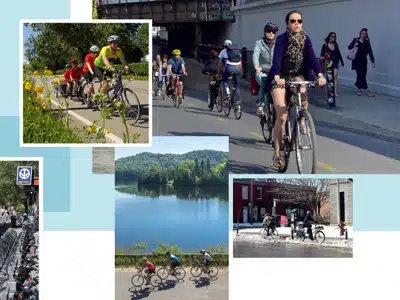
In a few days, we'll leave early in the morning, as Montand sang, for the 35th Tour de l'Île. When you look at what cycling was like in Montreal and Quebec at the time of the first edition, 1985, But it has to be said that we've come a long way. First of all, bicycle use has exploded! This is true in Montreal's central districts, but it's also true in many other cities. A few days ago, the origin-destination survey for the Quebec City agglomeration was published. It confirms an impressive increase in cycling in the national capital.
But there's more. Tour de l’Île de Montréal was a veritable social marketing machine, one that started spinning and never stopped. An invitation to «get the beciks out of the garage», an invitation to create other events, all over Quebec. Now, hardly a weekend in spring or summer goes by without a cycling event taking place somewhere. With several successful years and 45,000 participants, there's no denying the impetus given by the Tour de l'Île to cycling in Quebec. Thirty-five laps later, the spirit is still the same: an opportunity to get back on the bike, celebrate this marvellous invention, and gently tell our elected officials time and again that our cities should be designed for people, not cars.
While it's true that, over the past thirty-five years, Quebec has set itself apart by investing in protected bicycle facilities, unlike many other parts of America, the fact remains that the pace at which the bicycle network is being deployed no longer meets demand. And I believe that, with the arrival of electric-assist bicycles, scooters and the like, it's high time to rethink the way streets are shared, to make more room for gentle, slow modes of travel that could very well compete with the solo car.
When I look at titanic road infrastructure projects like the new Champlain Bridge or the dismantling of the Bonaventure Expressway, completed at a cost of billions of dollars in incredibly short timeframes, I'm always amazed at how little is invested in cycling, and how long cycling projects take to see the light of day. Yes, we've come a long way, but this is no time to be idle! The challenges are enormous as the number of bicycle trips continues to grow.
Suzanne Lareau
President and General Manager