

Urban bike parks: an enduring trend?

Portrait of a new, low-maintenance municipal and community leisure facility.

Mountain bike enthusiasts and clubs have long been building dirt tracks for their favorite sport. The upkeep of these facilities requires constant commitment to mitigate the impact of bad weather. It's not for nothing that BMX tracks have for many years featured asphalt curves, as this reduces maintenance and ensures a durable shape over time. Reducing maintenance at the cost of losing some experience. In the end, the gains outweigh the costs for a municipality.

The professional creation of pumptracks and recreational trails is a relatively recent phenomenon, but one that is expanding rapidly as municipalities take an interest in these infrastructures in response to public demand. Municipal realities make it difficult to design, build and maintain these types of facilities, as they require very precise knowledge, often acquired through long years of experience.

For large-scale projects, municipalities are increasingly turning to professionals for design, site supervision and construction.
Europe

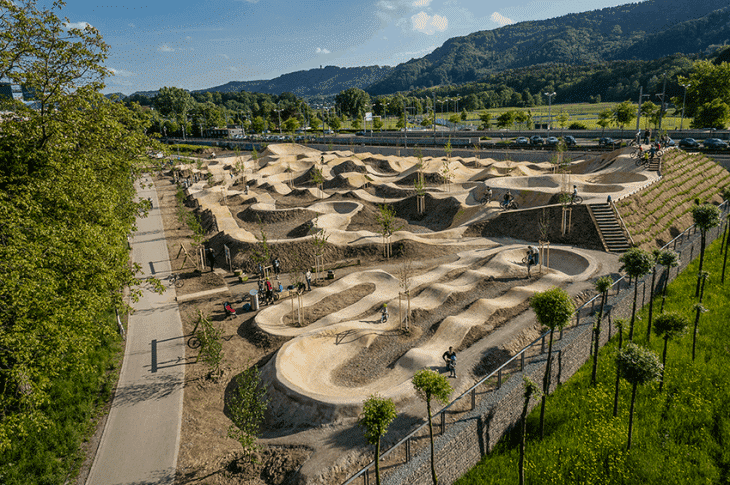
A European innovator in concrete pumptracks, the Swiss company Vélosolutions produced the Zurich bikepark, after projects in Bali and Thailand.

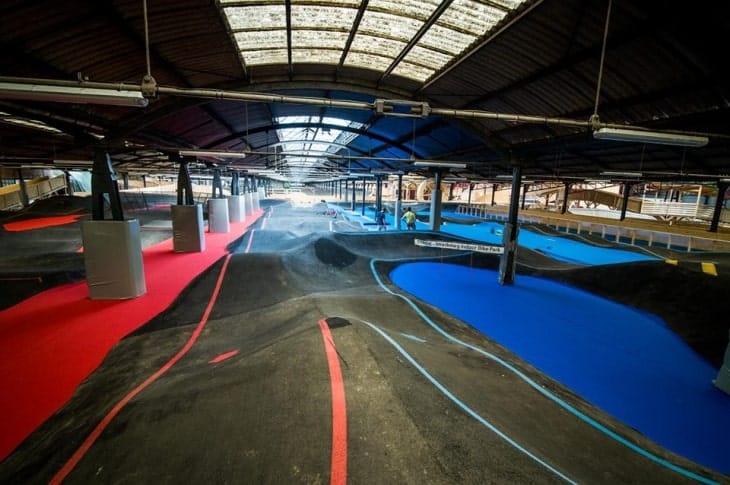
In France, the Bike Solutions has completed a number of asphalt projects, including the pumptrack section of the Stride Strasbourg indoor bike park. The special feature of this project is that it integrates pumptrack-style modules and color-coded paths. This development is part of a a vast project costing over 1.3 million euros which offers facilities for different types of clientele under one (very large) roof.

Zurich Bikepark

Stride Strasbourg Indoor Bike Park

North America

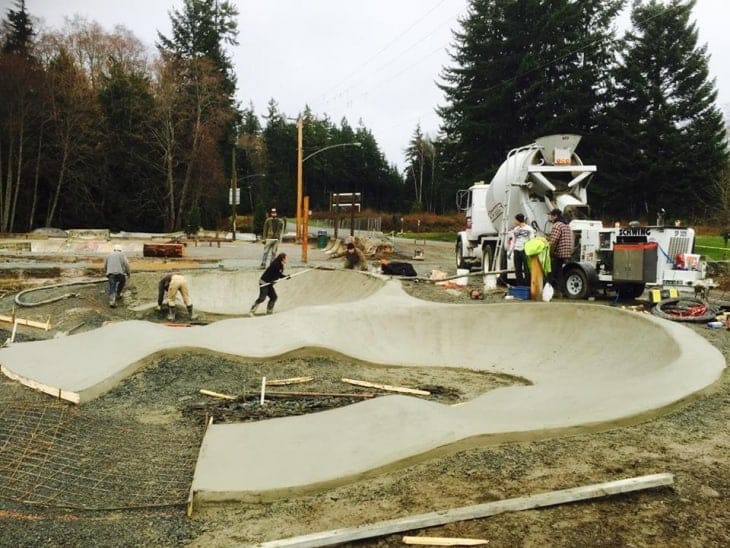
In 2014, the British Columbia-based company Alpine Bike parks has produced a concrete pumptrack in Powell River, British Columbia, on land adjacent to a skatepark. Its design is inspired by a track created for a major sporting event. The track is currently the only one of its kind in Canada, if not North America.


Powell River, shaping the steel-reinforced concrete structure

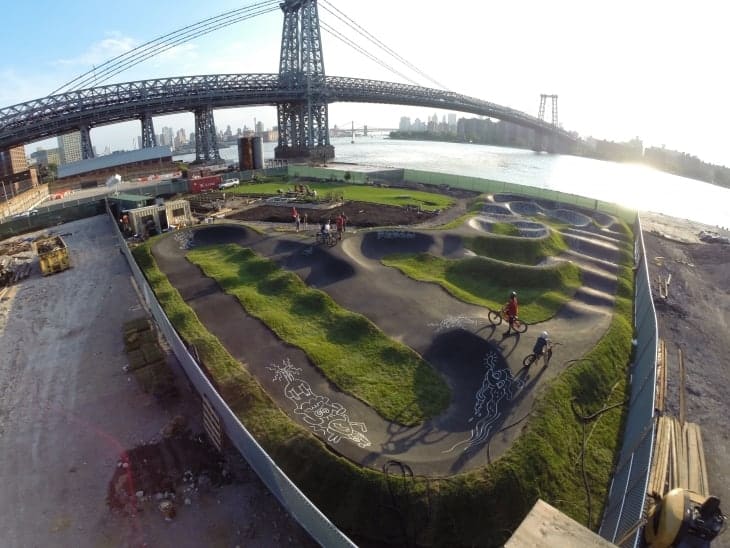
Brooklyn Bike Park

In Quebec

In Québec, several skateparks have used the concrete technique, notably at Repentigny in 2013 and Verdun in 2015. The technique has not yet been applied to cycle tracks, but it will soon be, as the construction technique (reinforced with steel bars) ensures durability that far exceeds that of asphalt. With asphalt, the main aspect to focus on is the foundation, which must ensure that the shape of bumps and curves remains stable through freezing and thawing, while the presence of steel bars in the concrete helps to stabilize the whole.

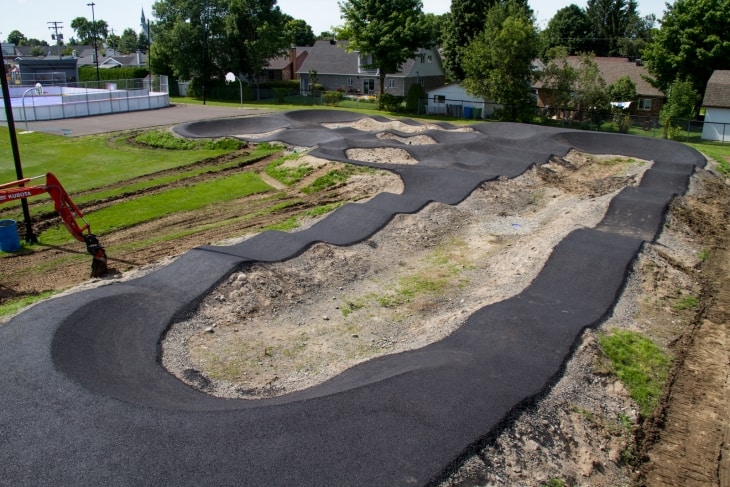
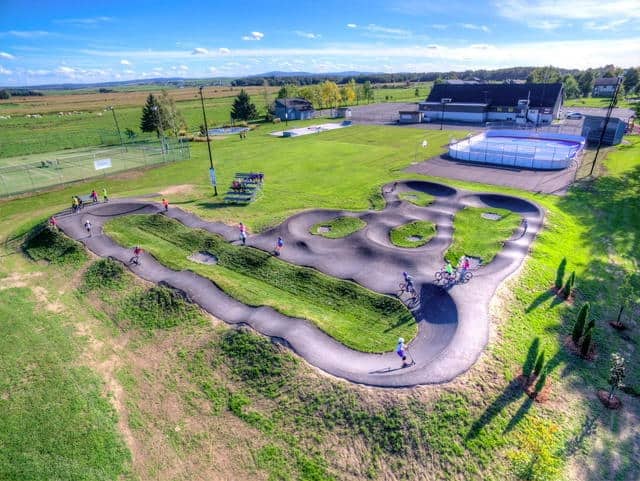
In 2016, the BMXpert, a leader in BMX track design and layout in Quebec, makes the leap to asphalt pumptracks, after more than 15 years of building asphalt turns for BMX tracks. They launch or are called upon to work on several projects, first in the aboriginal communities of Mistissini (recreational trail) and Saint-Bernard in Beauce (Quebec's first asphalt pumptrack), then to Lac-Simon (pumptrack made by Boreal Trails and asphalted by BMXPert). At the time of writing, the team is producing a 4th track at Waterloo, Qc.

The Saint-Bernard runway, before landscaping

After landscaping

Concrete/asphalt or earth?

Advantages and disadvantages of concrete or asphalt vs. earth

Benefits

  • More durable surface
  • Drastically reduces maintenance costs and frequency (amortized over several years, representing financial and human savings)
  • Can be used by more types of customers (skateboards, roller skates, scooters)
  • Greater traction than soil (when dry, it tends to lift)
  • Can be used even in the rain or winter

Disadvantages

  • The higher initial realization cost may be inhibiting to the sale of the project
  • Reduced quality of experience for some customers (who prefer the natural feel of the land)
  • Higher potential for minor injuries* (abrasion following a fall)

Construction

For this type of special project, the «design-build» project format, Design-build) is sometimes used because it is based on cutting-edge knowledge, often in a niche market.

However, the format is not without its detractors, as it sets aside the tendering process and, for municipalities, creates a degree of artistic vagueness for the public. The public needs to be reassured about the qualifications of the contractor selected, the criteria used to make the choice, and the monitoring of expenditure throughout the project. Customers need to be sure that their needs are clearly expressed, and that the contractor understands them.


In the end

Quebec expertise is well on its way to realization, and that's good news for Quebec practice, because the’The state of cycling in Quebec in 2015 lists 620,000 adults mountain bikers in Quebec. Let's bet that more of tomorrow's adults will be mountain bikers if they've had this kind of facility since childhood!

*Note on injuries: Since cyclists wear helmets, the wheels never leave the ground and speeds remain relatively low (at least for new riders), and since the areas surrounding the pumptracks are covered with peat or some other fall-absorbing material (cedar mulch, for example, although this is not recommended), the most frequent injuries recorded among clubs using this type of infrastructure remain abrasions, resulting from slipping after a fall.
Wearing protective equipment remains recommended.


×