










The ministère des Transports du Québec recently launched the first call for tenders for major rehabilitation work on 5 kilometers (the elevated section) of the Métropolitaine highway in Montreal. The work was necessary to prevent the highway from collapsing!
The announcement raised many questions. Why not bury the freeway as the Big Dig in Boston? Why not make this infrastructure the High Line* of Montreal? Why not put everything at ground level, like the recently resurfaced section of the Bonaventure Expressway? In fact, all these questions are legitimate, and all revolve around the same big question: why redo everything the same? Why can't we dream and wish that this urban scar could be erased for the benefit of the people who live nearby and all those who have to cross this axis on foot or by bike? This is a matter for debate. We need to see how we can take advantage of the refurbishment of this major road, sixty years after its construction, to at least partially correct the harmful effects of this scar.
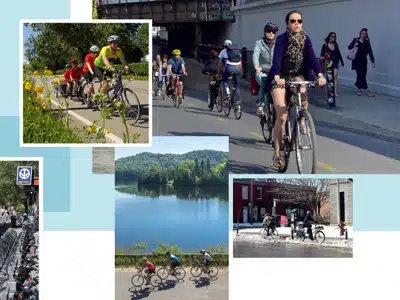
In terms of active mobility, the most detrimental effect of this expressway, apart from the poor air quality, is the fact that this urban highway, even when elevated, is a major obstacle for pedestrians and cyclists who have to cross its service roads (boulevard Crémazie) every day. The death of cyclist Clément Bazin in 2018 is a sad illustration of this. If we exclude the north-south axis (Christophe-Colomb) and a tunnel path in the Pointe-aux-Prairies nature park, this highway has no protected crossing worthy of the name in its elevated section, as real crossings for pedestrians and cyclists should be.
As citizens and organizations from adjacent neighborhoods (Ahuntcycle, Association des piétons et cyclistes de Villeray-Saint-Michel-Parc-Extension, among others) have been requesting for some time, work should be undertaken in the short term, jointly by the Ministère des Transports and the Ville de Montréal. Let's take advantage of this refurbishment to create at least several crossings under the Metropolitan Autoroute, equipped with the best physical features and signage and lighting technologies, to ensure truly protected transit for cyclists and pedestrians. So much for the short term. In the longer term, with a view to Mink zero and sustainable mobility, let's allow ourselves to dream and take part in the ideation process of what could ultimately become of this poorly treated urban corridor, a sad reminder of the way we planned in the 1950s and 1960s.
*In New York, the High Line is a suspended urban linear park in the borough of Manhattan, built on a portion (2.3 km) of the Lower West Side's former overhead railroad tracks.
Suzanne Lareau
President and General Manager
Things are also moving in Quebec City. On January 27, the city held a consultation on its road safety strategy, which will notably review the sharing of public roads between different users. You can read Vélo Québec's recommendations here..