











On Tuesday, February 6, the Parliamentary Commission studying Bill 165 to amend the Highway Safety Code (HSC) began its work in Quebec City. In the brief it presented, Vélo Québec made an exhaustive analysis of the bill, highlighting several good ideas and suggesting very concrete and more ambitious improvements that go beyond simply catching up with the reality of our streets and roads.
Good ideas :
- The precautionary principle
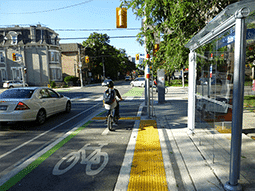
- New shared spaces such as bike lanes and shared streets
- Discontinuation of demerit points for cyclists
Improvements to be made :
- An unequivocal principle of prudence - It must affirm that it is first and foremost drivers of motorized vehicles who must be attentive not only to other vehicles, but also to the other human beings around them.
- The notion of priority in bike lanes and shared streets - Pedestrian and cyclist priority needs to be affirmed more strongly than it is in the current bill for these two types of environment. Motorists in these environments are in a sense «guests».
- Penalties based on dangerousness - Bill 165 puts an end to a long-criticized inequity by abolishing demerit points for certain cycling offences. On the other hand, the increase in fines is substantial! Vélo Québec continues to advocate for penalties that are proportional to the danger to others, and calls for penalties to be lowered to between 30 $ and 50 $.
- A head start by bike - The new Highway Safety Code must not hesitate to give bicycles a head start. We therefore ask that cyclists be allowed to use pedestrian lights, except in cases where pedestrian/cyclist cohabitation in the same phase is not compatible: simultaneous pedestrian crossings in all directions, high pedestrian flow. That said, cyclists must always give priority to pedestrians and adopt walking speed.
Vélo Québec's analysis suggests a number of other adjustments and nuances to ensure greater consistency between the desire to better protect the most vulnerable and the concrete ways of doing so. Click here to consult Vélo Québec's brief.
Until February 14, several other organizations will be heard on the bill at the National Assembly. Individual comments are also accepted on the National Assembly website under Transport and Environment Committee. All voices added up can make a difference!
Suzanne Lareau
President and General Manager