


- Driving in Quebec
- Events and activities
- Consulting and training
- Programs and campaigns
- Magazines and publications
- News and issues
- About us
- Contact us
- Become a member
- My account
- French









Home Toolkits Security Drive safely and share the road Cycling best practice videos
Cycling best practice videos
Share
Whether you're a cyclist, pedestrian or motorist, every little gesture counts in making the road safer and friendlier for everyone. Watch the video clips produced for our 2012 campaign on sharing the road.

Sharing the street
Whether you're a cyclist or a motorist, sharing the road requires constant attention. Being aware of each other's presence on the road is the beginning of sharing the road.
Be visible
Cycling at night happens more often than you think. Having a bike equipped with reflectors and active lighting is compulsory and indispensable. Many cyclists mistakenly believe that city lights are all they need to be seen. If people can't see you, they can't pay attention to you.
Respect the highway safety code
When cycling, it's important to respect the rules of the Highway Safety Code. It's a question of common sense, safety and respect for pedestrians and motorists. Being courteous to other road users is an excellent way of earning their respect.
Managing conflict situations
Intersections are the most common place for all road users to collide. But there are many other potentially conflict-ridden, even dangerous situations: right-hand turns at intersections, blind spots, excessive speed and car doors that open unexpectedly.
Overtaking
As cyclists, we sometimes have to overtake another cyclist, or a stopped or double-parked car. Overtaking should always be done from the left. Motorists overtaking cyclists must give them 1 m of space in town and 1.5 m on rural roads.
Adjusting your headphones
It's not enough to put a helmet on your head, you also need to choose one that fits properly and is approved by recognized certification bodies. The helmet must be stable and cover the top of the head; it must not flop around or fall on the forehead or neck.
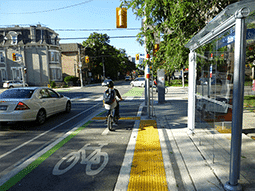
Improving bus/bike cohabitation
When it comes to mobility and transportation cocktails, bicycles and public transport are natural allies. On the street, however, the cohabitation of bus and bike requires certain precautions.
Going the right way
Bicycles must travel in the same direction as cars. Normally, cycle lanes on the roadway dedicate a corridor on the right-hand side of the roadway to bikes. More and more, however, new cycle lanes are appearing, transforming a one-way street into a two-way one.
Group rides
Outside urban areas, it's important to plan your route. In a group, cyclists ride in single file: this technique works well and saves energy. Motorists passing a group of cyclists should maintain a distance of 1.5 m from them.
Riding with children
A bicycle is a child's first means of transport, and can provide extraordinary independence, provided the child has mastered its use. Your child can acquire this mastery if you multiply the opportunities to ride with him or her.
Signal your intentions
Motorists have their indicators, cyclists have their arms. Cyclists must clearly indicate the direction they wish to take.
Membership
Vélo Québec needs your help
By becoming a member of Vélo Québec, you support our mission to develop and promote cycling, and help us build the cycling Quebec of tomorrow.
All rights reserved 2026
Vélo Québec
Conception de sites web : PAR Design, Agence Web