











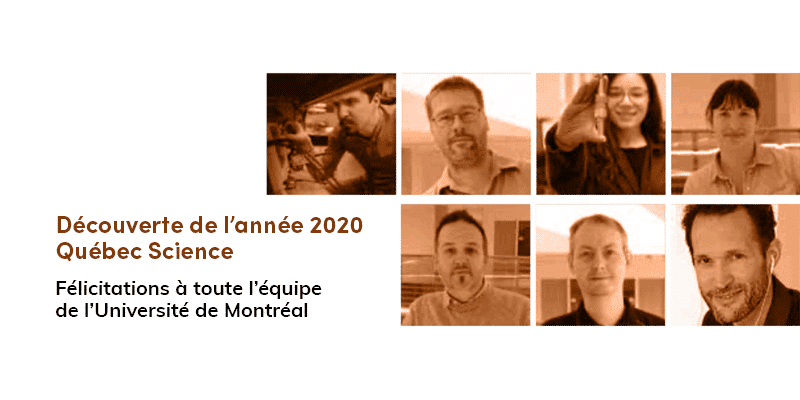
Montreal, March 17, 2021 - For 28 years now, the Québec Science continues the tradition: every autumn, a jury of researchers and journalists selects the 10 most impressive Quebec discoveries of the past year, and the public is then invited to vote for the one of their choice. This year, it was the innovative recipe found by chemists and physicists for making a safer, greener lithium-ion battery at lower cost that won readers' hearts.
The hopes of the energy transition rest largely on lithium-ion batteries. Their ability to store energy could propel the production of electricity from irregular renewable sources such as wind and sun. But there's a downside: their design requires products that are harmful to health, safety and the environment.
Scientists at the Université de Montréal have joined forces to bring together two components that would not normally be compatible in a lithium-ion battery: carboxymethylcellulose (CMC), a binder derived from forestry residues, and a water-based electrolyte. CMC is soluble in water.
Steeve Rousselot and his colleagues at Université de Montréal's Laboratoire de chimie et électrochimie des solides called on their colleagues at the Canada Research Chair in Highly Reactive Plasma Physics, who were experimenting with the effect of plasma on wood and cellulose. Plasma is created by subjecting a gas, such as helium, to an electrical voltage. The material becomes unstable and changes state, as in an aurora borealis or a lightning bolt. «With this high energy, we can form certain bonds between atoms and molecules that would be very difficult to reproduce in conventional chemistry, and thus create new materials», stresses Jacopo Profili, physicist and lead author of the article.
The team succeeded in designing a plasma coating that repels water while allowing lithium ions to pass through to charge and discharge the battery.
The good news is that the plasma production equipment can be easily integrated into an industrial production line. This battery is ideal for storing energy from wind turbines or solar panels. It also offers a major advantage: there's no risk of it catching fire or exploding, or of chemicals being released into the environment, and it's easier to recycle at the end of its life.
«We are delighted and honoured to have been named Scientific Discovery of the Year 2020 by Québec Science. This prize rewards the excellent interdisciplinary work carried out by our two teams. It also confirms the public's awareness of the need for eco-design and the use of local resources in the manufacture of everyday products. Our process for developing a water- and wood-based battery is still in its early stages, but we and the entire scientific community are continuing our work to offer sustainable solutions for tomorrow's energy considerations,» say Mickaël Dollé and Luc Stafford, professors at the Université de Montréal and co-directors of this research.
«Concerned about climate change, our readers saw in this ingenious technology a concrete response to the unavoidable transition to green and renewable energies and the need to commit to a circular economy,» mentions the editor-in-chief of Québec Science, Marie Lambert-Chan.
Also taking part in the discovery were Erica Tomassi and Elsa Briqueleur from the Université de Montréal, and David Aymé-Perrot from Total.