








Jean-François Pronovost's presentation to the Commission de consultation de la mobilité entre Montréal et la Rive-Sud (Consultation Commission on Mobility between Montreal and the South Shore)
It's a happy coincidence that this third thematic meeting of the Commission de consultation sur l'amélioration de la mobilité entre Montréal et la Rive-Sud is taking place during the Féria du vélo de Montréal, a week dedicated to cycling and urban living. Toronto, too, is currently celebrating a week dedicated to cycling.
Last Tuesday, we were pleased to unveil a new Taxi + Vélo pilot project. Some 80 cabs from Laval, the Island of Montreal and the South Shore are now equipped with bike racks and can carry passengers and their bicycles.
Yesterday was dedicated to bicycle transportation. Over 200 companies and schools accepted Tour de l’Île de Montréal's invitation to take part in this V-Day. On the same day, some 100 municipal and government officials, transportation planners and consultants took part in technical workshops on planning the metropolitan bicycle network and integrating cycling with public transport.
This meeting of professionals, which would have been unthinkable 30 years ago, bears witness to new trends in personal mobility. The emergence of the bicycle in the cities of industrialized countries is a real phenomenon, leading us to consider mobility issues in a more complex way than before.
In its May 28 issue, US NEWS & WORLD REPORT magazine reports the results of a survey carried out last September among a representative sample of the American population. The question asked was: »Which of the following is the best long-term solution for reducing traffic in your state? Building new roads, improving mass transit or developing communities where it's not necessary to travel long distances to work or shop?»
I read this question to a few colleagues and asked them to guess the results of the poll. My colleagues answered unanimously: the American population votes for more roads. After all, aren't the United States the cradle of the automobile, and haven't they just elected a president who is not very ecologically minded?
Yet the survey results paint a very different picture of our neighbors' aspirations: three-quarters of respondents favored better public transit or less car-dependent communities, while only 21 % called for new roads.
My little exercise is by no means scientific, and any survey has its limits. It's also true that our perceptions often differ from reality. After 20 years of promoting cycling, I can testify that when it comes to transport, prejudice is alive and well. Our fellow citizens are often described as slaves to a passion called the automobile. I'd like to qualify this perception: like many love stories, this passion is subject to change - a natural inclination or a conditioned tendency?
If the trend continues... evokes the Commission's document, which feeds our reflection today, our fellow citizens will use the car even more. They will do so despite all the rhetoric in favor of public transport. The document adds: »Cycling and other alternative modes are still finding it hard to find their place on existing networks. Complementarity between modes of transport remains a challenge.»
We all agree that car use will increase if we continue to pay lip service to public transport and other alternative modes. Our fellow citizens don't really choose the car. It's transport and land-use planning decisions that make the car almost compulsory.
Who hasn't heard someone explain that the journey from home to work takes twice as long by public transport as it does by car? This situation of disadvantage is too common not to be a systemic vice.
Apart from some interesting initiatives, such as the metro, reserved lanes and AMT interventions, public transit is still too often a mode of transport for those excluded from the car: the young, the poor, the disabled and the elderly.
Over the past decade, transport companies have made real efforts to improve the quality of their customer service. However, the improvement in service quality has been partly offset by a reduction in the quantity of service. Let's not forget that transport companies have also been the target of budget cuts.
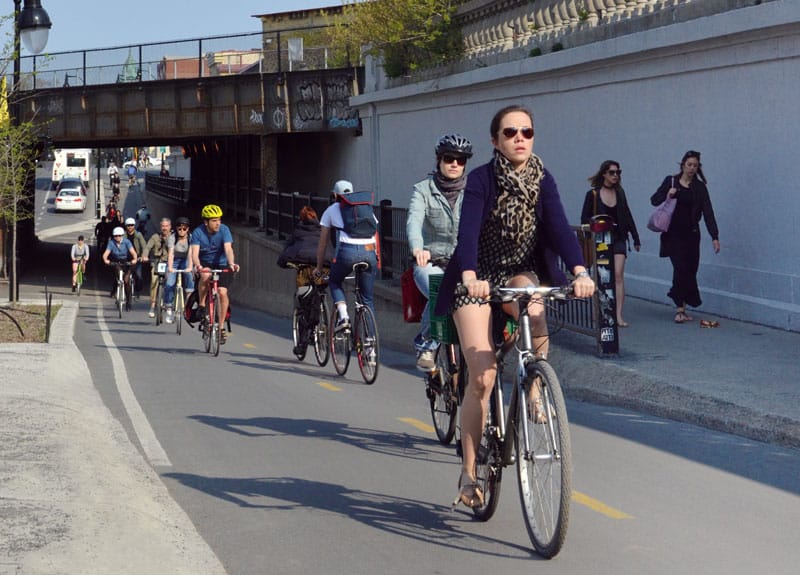
I'm surprised to see that more than 240,000 people, or 10 % of adults in the Greater Montreal area, declared last summer that they commuted by bike, either daily or occasionally. I should point out that these 10 % are adults. Of course, 18- to 24-year-olds are more likely to get around by bike than those aged 55 and over. But on the island of Montreal, a quarter (26 %) of cyclists aged 35 to 44 use bicycles to get around.
I say that I'm surprised by these results, because investments to promote this means of transport, even if they have increased in recent years, are still marginal. How many municipalities in the metropolitan area have a bicycle parking policy? How many have built bicycle links to connect residential areas, downtowns, shopping centers, industrial parks, schools and major entertainment hubs?
Let's take a few examples from the South Shore.
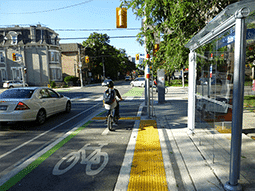
For the past ten years, cyclists have been able to access the Jacques-Cartier Bridge on one of the sidewalks. The bridge will soon be even more accessible by bike, with a new path to be built as part of the bridge rehabilitation project. On the Montreal side, access to the bridge is via a bike lane. On the Longueuil side, look for the path! And we still don't know if there will be a bicycle link with the path that will be built on the bridge.
We're delighted that the number of bicycle parking spaces has finally been increased at the Longueuil metro station. But you have to be able to get to the metro. Of course, fortune favors the bold, but we also know that, in the Montreal region more than anywhere else in Quebec, cyclists ride in bike lanes because of the high flow of motorized traffic. Do you think this kind of non-development is conducive to a bicycle link between the South Shore and Montreal?
I could complete this picture by citing the absence of bicycle racks on buses linking the two shores, a feature found on more than 200 transport companies in North America.
Thanks to its flat topography, the South Shore offers ideal conditions for cycling. It is well served by recreational bike paths. And yet there are virtually no facilities (bike lanes and parking lots) to enable you to get from one point to another efficiently (without detours) and safely, even though there's plenty of space.
If only efforts were made to make bicycle travel safer and easier, journeys currently made by car could be made by bicycle. What's true for the South Shore is also true for the entire metropolitan region. The 10 % of adults who currently commute by bike could double. And I'm not even talking about what could be done to get kids to school by bike instead of by car. In some neighborhoods and municipalities, bicycle use could almost reach rates comparable to those in Northern Europe.
Rely on the transport cocktail
My intention is not to suggest that you send your cars for recycling and convert to cycling. I simply want to emphasize that the bicycle can make a contribution to our travel needs. In fact, it's an efficient vehicle for short distances and offers many advantages as an individual mode of transport. This contribution will be multiplied tenfold if it is combined with public transport, to which it brings the advantage of flexibility.
Following the example of Michel Labrecque in an essay published in 1997, we could even imagine creating a transportation cocktail, with public transport as its backbone. Other modes of transport would be organically added: cycling, walking, car-sharing, car rental and cabs. This transport cocktail approach could even be translated into a commercialized service. Like the CAM, we'd invent a cocktail transport card that would give access to public transport, membership of a car-sharing club and discounts on cab fares.
This transport cocktail proposal is an invitation to find ways of competing effectively with the car on a significant number of journeys, so that families have other transport choices than a second or third car. This would be a definite economic advantage... and there are others.
More and more CEGEP students are driving to class. That doesn't seem like much progress to me. This new generation already tends to be physically inactive, and the money spent on travel could be better invested in cultural and scientific development.
Our mobility needs are more numerous and complex than ever before. We need to promote greater, more efficient mobility. To achieve this, we need to put an end to the belief that there is a single solution to our travel needs. Paradoxically, we need to put the car at a disadvantage in order to develop an effective range of travel modes. So, while the car will remain unbeatable for certain journeys, it will no longer be the only way to get around.
This discussion of a link between two shores takes me to the realm of societal choices. To my knowledge, no city, MRC or government has decided to reduce the number of trips made by car on its territory. Under these conditions, we should stop being surprised that the trend is towards greater use of the car. It's the mode of transport that has benefited and continues to do so. But this choice is beginning to show its shortcomings. In the cities, people now ride in carriages that move at the pace of a donkey. Some mornings, crossing bridges is an interminable stressful experience, forcing some of the population to get up before the rooster crows.
Until now, congestion problems such as the one we're facing have been solved by building road infrastructure. The foreseeable effect of highways and bridges, however, is to increase the number of cars even more, and create even more intractable congestion. Atlanta and Los Angeles, which are investing in freeways, are notorious for their endemic traffic jams.
The quality of life in our central city is a key factor in the international competitiveness of the metropolitan region.
A new bridge between the South Shore and Montreal will encourage South Shore households to motorize more, and it will end up clogged with traffic jams. Meanwhile, Montrealers, half of whose households live in central neighborhoods like Centre-Sud and Plateau Mont-Royal, will have to endure an additional avalanche of motorized trips. Do we believe that this will improve the quality of life in our metropolis, a quality of life that is today a central ingredient of economic competitiveness?
Over the past few years, Montreal has featured on several lists of the world's best cities. We've seen our metropolis stand out in the company of cities such as Portland in Oregon, Copenhagen, Seattle, Trondheim in Norway and Antwerp. All these cities boast a high quality of life, an abundance of cultural activity and an enviable economic situation, generally due to the strong presence of the new economy. What these cities also have in common is that they give pride of place to modes of transport other than the private car. Several of them are renowned for the place they reserve for bicycles. If we try too hard to imitate Atlanta and Los Angeles, we run the risk of looking like Bangkok and Mexico City.
At the start of my speech, I quoted a survey carried out in the United States which gave a different picture of the aspirations of American citizens than the current perception. At the bicycle conference that brought together nearly a hundred specialists from the Montreal region, an eminent American planner, Dan Burden, who has advised over 200 American municipalities in the last five years, came to present his vision and his work. His talk could have been jokingly titled: "How do you transform Taschereau Boulevard into a pleasant, pedestrian- and cyclist-friendly environment? Mr. Burden presented nearly a dozen successful examples.
Taschereau boulevards are the product of a transportation approach that bases travel on the automobile. Nobody likes the Taschereau boulevards. Let's start converting them.
Vélo Québec
Founded 33 years ago, Vélo Québec is a non-profit organization whose mission is to encourage and facilitate the free and safe use of bicycles for recreation, tourism and transportation. Its mission is to promote a better quality of life and protect the urban and rural environment. Vélo Québec has members in every region of Quebec. Over the years, it has set up a publishing house (Les Éditions Tricycle) which publishes the magazines Vélo Mag and Géo Plein air, as well as a number of hiking guides and maps. Vélo Québec is also behind Tour de l’Île de Montréal, now an independent entity and a veritable machine for promoting cycling and bicycle tourism. Its agency, Les Voyages du Tour de l'Île, takes more than 4,000 Quebecers on tours of Quebec, Canada and Europe every year.
Vélo Québec is behind a number of initiatives in the field of bicycle facilities and road safety, including the publication, in collaboration with the Ministère des Transports, of two editions of the Guide technique d'aménagement des voies cyclables.
Finally, since 1995, Vélo Québec has been coordinating the development of the Route verte, a cycling itinerary which, by 2005, will cover more than 4,000 kilometers. Since 1998, it has also been the initiator and coordinator of the Réseau vélo métropolitain in the Montreal region.