



















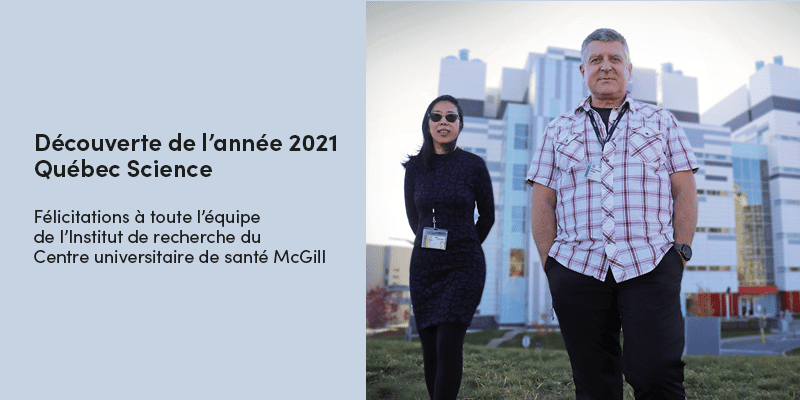
The 2021 Québec Science Scientific Discovery of the Year Award goes to Jean-Jacques Lebrun's team at the IR-CUSM, for uncovering the genetic mechanisms at work in triple-negative breast cancer and discovering a promising targeted polytherapy.
Montréal, March 22, 2022 - For 29 years Québec Science continues the tradition: each fall, a jury of researchers and journalists selects the 10 most impressive Quebec discoveries of the past year, and the public is then invited to vote for the one of their choice. This year, it's the discovery that uncovered the genetic mechanisms at work in aggressive triple-negative breast cancer, and the discovery of a promising new treatment, that has won readers' hearts in the 2021 Discoveries of the Year competition.
Every day, 75 Canadian women are diagnosed with breast cancer, and 15 die of it. To date, there is no targeted treatment for the most aggressive form of the disease, but thanks to a discovery by the team of Jean-Jacques Lebrun, MSc, PhD, a researcher at the Research Institute of the McGill University Health Centre (RI-MUHC), things could change.
How about a fresh start?
That's what Jean-Jacques Lebrun had in mind when tackling «triple-negative» breast cancer, one of the most aggressive forms of the disease. It accounts for around 15 % of cases, but is responsible for half of all deaths. «The only remedies are chemotherapy and radiotherapy, which don't work very well. The risk of metastasis and recurrence is high,» explains the researcher.
To find the Achilles« heel of these tumors, his team combed through their entire genome to find the genes that play a predominant role in the tumor process. The team grew cancer cells from triple-negative breast cancer patients in the laboratory and »turned off« their 20,000 genes one by one using CRISPR-Cas9 technology - a kind of »genetic scissors". These cancer cells were then transplanted into the mammary glands of mice. As they multiplied, the researchers were able to deduce the capacity of each gene to slow or block tumor development.
The team identified two major signaling pathways, i.e. two «networks» of genes that modify cell behavior. One of these, the mTOR pathway, is known to be deregulated in several cancers and to promote anarchic proliferation. The other, the Hippo pathway, is conversely a protective pathway: under normal circumstances, it protects cells against tumor slippage.
The researchers then tested drugs that could target these pathways and found two effective ones: torin 1, a second-generation drug known to block the mTOR pathway, and verteporfin, a drug normally used for retinal disease that can activate the Hippo pathway. After testing them on cancer cells from hundreds of patients affected by different subtypes of triple-negative cancers, the researchers discovered that the two drugs administered together had an effect greater than the sum of their individual effects, and succeeded in eradicating the tumor.
Posted in Nature Communications, These results are the fruit of five years' hard work. The next step will be to set up clinical trials, a task which Mr. Lebrun is currently tackling. Lebrun.
«Cancer affects us all in one way or another, and every year we notice that readers are keenly aware of advances in oncology. This discovery is encouraging, as it brings with it concrete hope of treatment,» comments Marine Corniou, journalist and deputy editor-in-chief of Québec Science.
«It's an honor to win this People's Choice Award with a discovery in basic research. To date, very few studies have used genome-wide CRISPR in vivo genetic screening, and ours highlights the power and robustness of this technology to identify innovative and clinically relevant therapeutic modalities in cancer. We know that many drugs fail in the clinical phase, but I'm optimistic, because we started from the mechanism to find a concrete solution,» says Jean-Jacques Lebrun, Senior Scientist in the Cancer Research Program at the Research Institute of the McGill University Health Centre and Professor of Medicine at McGill University.
«On behalf of the entire community of the Research Institute of the McGill University Health Centre, I would like to congratulate Dr. Lebrun and his team on this hopeful discovery. We are proud to offer researchers like Dr. Lebrun an environment that brings together biomedical research and clinical medicine. As the largest hospital-based research institute in Quebec, the RI MUHC accelerates the translation of basic discoveries into public health, helping to improve the health of children and adults throughout their lives,» says Dr. Rhian Touyz, Executive Director and Chief Scientist of the RI MUHC.
Also taking part in the discovery were : Meiou Dai, Gang Yan, Ni Wang, Girija Daliah, Sophie Poulet, Julien Boudreault and Suhad Ali (Research Institute of the McGill University Health Centre), and Ashlin M. Edick and Sergio A. Burgos (McGill University).