









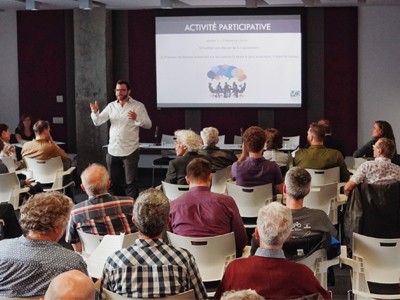




Montréal, Tuesday, May 28 - As part of the Go vélo Montréal Festival, presented by Lait in collaboration with Desjardins, Vélo Québec is pleased to welcome Marie-Astrid Leray, founder of Le Vélo à Gaufres and co-president of Les Vélo à Gaufres. Boîtes à Vélo France as guest speaker. On this occasion, she will address the potential of the cargo bike as a promising and versatile alternative to motorized transport, offering an efficient solution for the mobility of people and goods, and for the development of bicycle-based entrepreneurship. The conference will be followed by a panel discussion featuring the following panellists: Brigitte White, citizen and mother, cargo bike user, and Julien Paquette-Verdi, engineer and urban planner, member of Loco-motion.
WHEN Thursday, May 30, 6 p.m.
WHERE Esplanade Tranquille, room The refectory
(1442 Clark Street, Montreal, QC, H2X 2R3)
Free admission | Conference in French Reservations required
Also available as a virtual package, via Zoom
CONFERENCE SUMMARY
Despite an economic and climatic context that calls for a reduction in the number of cars on our roads, and despite government policies in favor of sustainable mobility, the number of vehicles on the road in Quebec has continued to grow over the past 25 years. This development has consequences for health, the environment and the economy: vehicle size is constantly increasing, GHG emissions linked to transport have risen by 60 % since 1990, and the growing use of the automobile encourages urban sprawl, which in turn promotes road congestion.
Whether for transporting people or delivering goods, there are alternatives and solutions that go far beyond simple electrification. Among them, the cargo bike is undoubtedly the most effective tool for reducing the nuisances associated with combustion-powered vehicles, whether in terms of GHG emissions, air and noise pollution, accidents, congestion or the costs associated with transport and delivery.
Drawing on her personal and professional experience, Marie-Astrid Leray sheds light on the meteoric growth of cargo bikes in France for personal and professional cyclomobility. The phenomenon is such that a nationwide trade federation of over 300 companies has been formed for 2019. Faster, quieter, more economical and more respectful of the environment, cargo bikes are emerging as the most effective solution to the many challenges posed by the growth of our cities and the delivery needs of their inhabitants.
The versatility of this type of bike, combined with technological advances in electric-assist bicycles, makes it particularly well-suited to delivery and professional mobility, as well as being an agile and relevant tool for everyday domestic tasks. Its rapid development is such that a number of challenges are looming on the horizon: cohabitation on increasingly busy and undersized bike paths, increasing size of bikes and trailers, inadequate and unsuitable parking spaces, etc.
Nevertheless, cargo bikes are positioning themselves as a tool for emancipation, and have revolutionized the world of cycling in recent years. Their potential to transform our mobility habits seems limitless. What if the cargo bike were the vehicle of the future for our living environments?