








As part of the 2025 municipal campaign, Vélo Québec presents its municipal program for bicycle development: six concrete commitments to make cycling an accessible choice for everyone, whether for transportation or pleasure.
For mobility, health, the environment and the economy, cycling is a winning solution for our cities.
Discover the program and invite your candidates to commit to a more bike-friendly municipality!
1. A safe cycling network to access all everyday destinations
2. Calming neighborhoods through street design
3. Real integration between cycling and public transport
4. Accessible and secure bicycle parking facilities, both at destination and in residential areas.
5. Bicycle education from an early age
6. Financial incentives to facilitate bicycle adoption
By going beyond myths and stereotypes, discover why cycling is a credible and promising solution for all Quebec municipalities.
1. A safe cycling network to access all everyday destinations
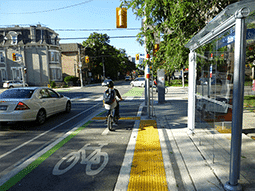
Develop and maintain a network of connected, protected and practicable cycle paths all year round, We've also developed a series of new, more efficient and safer bicycle paths between the main residential, economic, commercial, institutional and healthcare hubs, making cycling a realistic option for all everyday journeys.
- Traffic congestion is on the increase in our living environments. In addition to their high financial cost for the population (more than $6 billion per year for Greater Montreal alone), and the time they waste (an average of 58 hours per person per year), the traffic jams cause stress, increase fuel consumption and greenhouse gas emissions.
- Yet a large proportion of journeys currently made by car-solo could be transferred to cycling in all its forms. For example, 18 % to 25 % of trips can be made by bicycle in Quebec's major cities. In Greater Montreal, between 17.5 % and 24.7 % of car journeys can be transferred to the EAB, and this figure rises to 46.5% with an electric cargo bike, which transports people and goods.
- Providing a safe cycling network also remains the most effective way of improving cyclists' safety: between 2000 and 2020, the number of seriously injured cyclists fell from 62%, Despite an increase of 29% in the number of cyclists and 51% in the number of cars on the road. This improvement in the road balance is directly linked to the increase in the cycling network, which grew by 111% over the same period.
2. Calming neighborhoods through street design
Traffic calming in residential neighborhoods and around schools, as well as on commercial streets, arterial roads and numbered highways under provincial jurisdiction.
- In the event of a collision with a car travelling at 50 km/h, the survival probabilities of a pedestrian is 25 %. This probability increases to 70% at 40km/h and to 90% at 30km/h. But when it comes to traffic speed, the street dictates the speed, not the sign. Making active travel safer therefore requires physical improvements that discourage through-traffic in residential areas, encourage people to slow down and promote good visibility between road users.
- The addition of bicycle lanes can also contribute to traffic calming: the the very presence of cycling infrastructure, especially those where cyclists are separated from motorized traffic, has the effect of slowing down the latter, thus increasing safety for all users.
- Calming efforts should not be limited to local streets: traffic on an arterial road, the presence of many lanes of traffic (especially at intersections) or the presence of parking lots (with a high turnover rate) are the three most important factors in calming local streets. main factors contributing to an increase in cycling insecurity. The installation of safe cycling infrastructure, separated from motorized traffic, on this type of road is therefore essential to make active travel safer.
3. Real integration between cycling and public transport
Provide secure parking and bike-sharing solutions at stations and main intermodal hubs; allow bikes on buses, metros and trains under clear conditions.
- The bike can be remarkably efficient on distances of 5 to 7 km, particularly in dense, congested urban areas. With the advent of the electrically-assisted bicycle (EAB), these distances can even go up to 10 or 11 km on average. But for longer distances, it's when combined with public transport that the bicycle reveals its full potential, constituting one of the most efficient means of covering the first and last kilometers of a travel chain. To achieve this, however, we need to create the right conditions for intermodality between active and public modes of transport.
- This involves a number of measures: authorizing bicycles on buses, metros and trains under clear conditions, but also developing interchanges that serve the whole territory and offer quality facilities for pedestrians and cyclists in all seasons. Their design must include destination facilities such as secure bicycle parking in sufficient quantity, easily accessible bike-share solutions and linking intermodal interchange locations (stations, bus stops, etc.) to local pedestrian and cycling networks, properly maintained in all seasons.
4. Accessible and secure bicycle parking facilities, both at destination and in residential areas.
Install covered racks and shelters at transport hubs, near shops, in public establishments and in the heart of neighborhoods, to encourage the adoption of bicycles, and in particular cargo bikes, by preventing theft.
- Bicycle theft is a major obstacle to cycling: after a theft, almost 45% of cyclists stop cycling or cycle less. Fear of theft also deters many people from acquiring a higher-value bike that better suits their needs. This can be particularly true for electrically-assisted bicycles (EABs), These can be used to cover longer distances or routes with steep gradients, or cargo bikes (including electrically-assisted bikes) that enable families to transport their children.
- More and more places to study or work are offering secure bicycle parking to their customers, ensuring the safety of their bikes during the day. But it's at the other end of the travel chain that the problem lies: unless they have access to a garage or shed, many citizens have no safe option for storing their bikes. It is therefore essential to multiply the number of secure bike lockers installed in residential areas, along the lines of those tested by the’sustainable mobility agency of Montreal.
5. Bicycle education from an early age
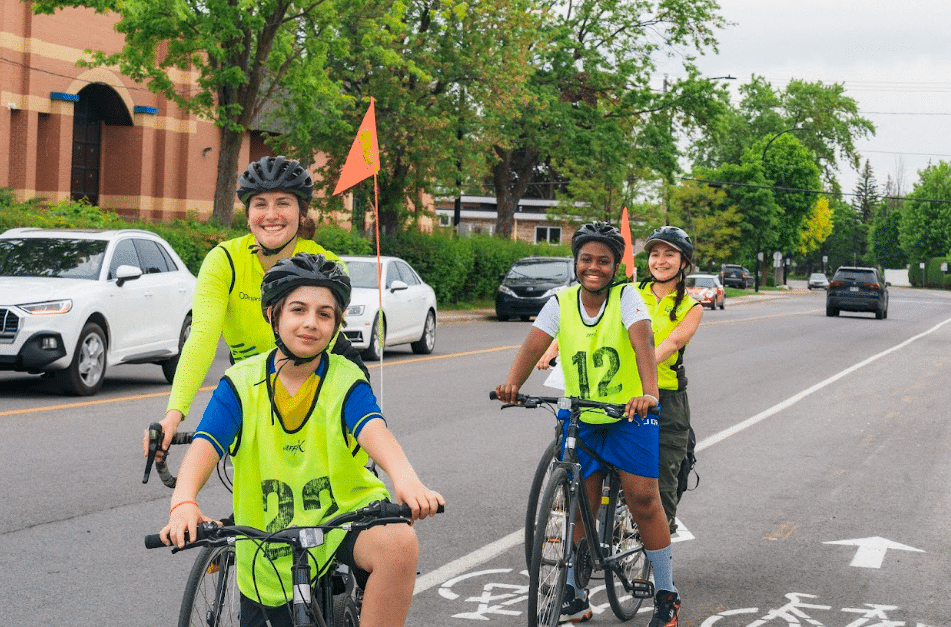
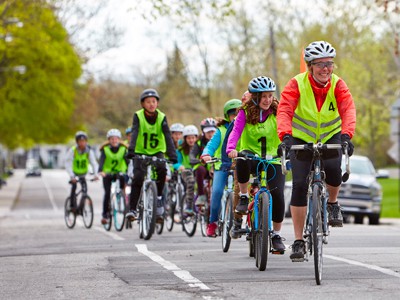
Facilitate learning to ride a bike in schools: support road safety education activities, create practice areas (bike education parks) and encourage bike-bus initiatives for children's travel.
- Already high among adults, inactivity rates among Quebec children are reaching worrying proportions, and these rates grow from year to year. In fact, since the 1980s, a major decline in cardiorespiratory health among young quebecers is observed, raising major public health issues.
- Exposure to cycling early in life helps to establish active habits over the long term, giving young people the keys to their first independent mobility tool. Unfortunately, this learning doesn't always take place in the family, so it's in schools that it can be universally taught. This is the path chosen by the most advanced countries in terms of cycling, such as Denmark and the Netherlands, but also Belgium and, more recently, France with its How to ride a bike.
- In Quebec, 37,800 children took part in the Cycliste averti in the last 10 years. Supported at the provincial level by the MELCCFP, the SAAQ and the Ministry of Education, the program nevertheless requires the support of municipalities and MRCs in order to reach its full potential.
- Other initiatives can encourage early initiation to cycling, including cycling education parks temporary or permanent, ideal learning environments for children aged 2 to 12.
6. Financial incentives to facilitate bicycle adoption
Offer subsidies for the purchase of bicycles, electric-assist bicycles or cargo bikes, as well as for the installation of secure parking and showers in workplaces.
- Offering financial assistance for the purchase of a bicycle, whether electrically-assisted, cargo or regular, is one way of relieving dependence on the car. The case of city of Denver, Colorado is clear on this point: the data collected following the first year of the program showed that people who benefited from the program covered an average of 42 km per week, for an estimated 3.4 motorized trips and an overall annual GHG reduction of nearly 2,000 tonnes, corresponding to around 435 cars.
- Creating well-designed, straightforward financial incentives also means investing in efficient, equitable and sustainable mobility assistance, particularly relevant for populations whose daily commutes are constrained by distance, capacity issues or lack of alternatives. These programs, already deployed on a large scale elsewhere in North America and Europe, have demonstrated their effectiveness when they are generous enough to influence behavior and include lower-income households. By relying on local partnerships for implementation, adapted categories (cargo bikes, adapted bikes) and clear rules to avoid premature resale, municipalities can ensure that these incentives promote a genuine modal shift and a fairer, more resilient mobility.