






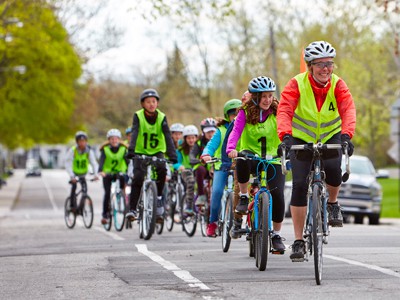



On February 6, Montreal announced that, as of spring 2018, Chemin Camillien-Houde would cease to be a transit route through Mount Royal. The decision was taken to improve the safety of cyclists, but above all to return to the very foundations of what a park like Mount Royal should be: a peaceful, friendly territory, free from automobile traffic with negative impacts on user safety and air quality. Despite the Town's decision, access to the mountain by car will still be permitted.
We were naturally delighted by this announcement, as were several organizations, columnists and editorialists, even if the details are still lacking to fully appreciate the project - visual projection of what could become a magnificent park path, improvement of the pedestrian experience, enhancement of the public transport offer, etc. - and we're still waiting for the details. Many have since taken to the barricades, claiming that an inalienable right has been taken away from them, with comments and hangups that have astonished us.
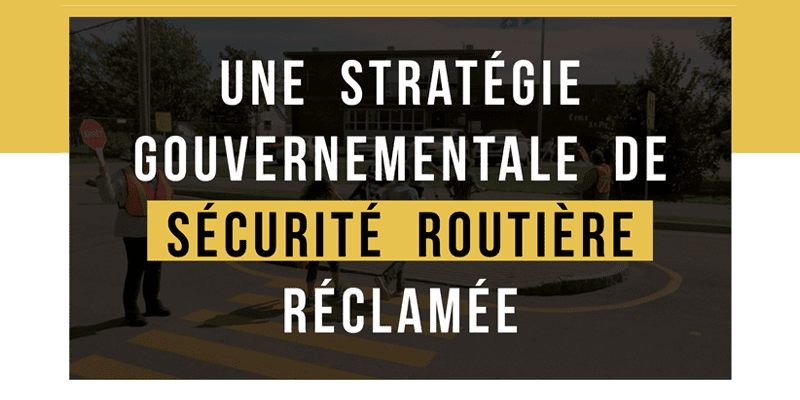
At the same time, the Parliamentary Commission on Bill 165 amending the Highway Safety Code began its work in Quebec City, where Vélo Québec presented an analysis. This, too, caused a stir among the all-auto crowd, who argued that cyclists should be treated in the same way as motorists, whatever the situation, and that giving cyclists a head start - with permission to cross at pedestrian lights or make a right turn at red lights in Montreal, for example - was becoming an unacceptable privilege that had no place in a highway code.
Last week, a report from the Communauté métropolitaine de Montréal revealed that there are now 142,000 more daily car trips to work than there were fifteen years ago, and that the proportion of workers using the car has also increased, to 65 % of trips. Public transit and active transportation to work have also increased in the Greater Montreal area, but the increase remains small, and does not affect the entire territory. In short, at this rate, we'll never achieve the objectives set out in the plans developed over the last fifteen years, particularly those set by the Quebec government to reduce greenhouse gases.
I've lost count of the number of public consultations in which we've taken part over the last ten years, and they've all come to virtually the same conclusion: we need to review our travel habits, reduce urban sprawl and rethink the role of the solo car. Land-use planning that gives priority to the private car is a costly and inefficient model - congestion is a major obstacle to our economic competitiveness - that has prevailed over the last fifty years and that our society can no longer afford to support. Even if GHG emissions are reduced with the electric car, we can't afford to encourage the endless growth of the car fleet, because a city congested with cars, whether gasoline-powered or electric, is not efficient for anyone.
The announcement of a halt to automobile transit on Mount Royal is a gesture that fits perfectly into this context of change. It won't solve the whole issue of the car's place in the city, but it's one that's bound to multiply in the years to come.
On the one hand, we're demanding that our governments take action to reduce our GHG emissions - the transportation sector alone is responsible for 40 % of GHGs in Quebec - and on the other, we're crying foul about a measure designed to reduce car space in the city. Isn't it time to take action?
Suzanne Lareau
President and General Manager