












The Groupe de discussion sur la sécurité des cyclistes, created by Transport Minister Robert Poëti, and made up of representatives from various sectors (municipalities, police, urban transit companies, trucking, coroners, CAA, SAAQ, MTQ, public health, academia and cycling groups), is highly relevant. Invited to reflect on cyclist safety, this group of 45 people will have held 5 one-day meetings by the end of the fall.
On August 14, the 6 cycling groups were invited to present their positions on the place of bicycles in the current regulatory context. In addition to the obvious convergence of their positions, the cyclists argued in favor of a Highway Safety Code (HSC) adapted to the characteristics of bicycles.
To modernize the CSR, Vélo Québec has suggested that the government adopt the Code de la rue approach, based on the principle of prudence. The philosophy behind this approach (in force in France and Belgium) is that the public highway is not dedicated exclusively to motorized traffic, and that every user has a place on it, especially the most vulnerable. The principle of prudence implies that drivers must, at all times, adopt a cautious and respectful attitude towards other road and street users.
At present, in the CSR, the bicycle has the same obligations as the car without having the advantages in terms of priority accorded to the pedestrian. We believe that cyclists have more to do with pedestrians than with cars. Accident statistics confirm that serious and fatal accidents on the roads are caused by motorized vehicles (cars, trucks, motorcycles) in 99 % of cases.
Vélo Québec has also made a number of concrete recommendations in favor of sustainable mobility: clarification of the safe distance to be respected when overtaking a car, sharing of sidewalks between pedestrians and cyclists when traffic on the road is dangerous (in a tunnel, for example), elimination of demerit points awarded to cyclists who have a driver's license (although this is not required for cycling), increasing fines and awarding demerit points to motorists for life-threatening offences such as swerving, the possibility of slowing down instead of coming to a complete stop at a stop sign, authorization to follow the indications of a pedestrian light when crossing an intersection, etc.
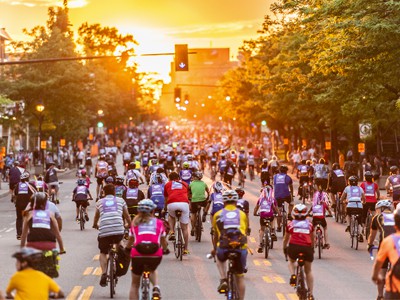
During the meeting, we noted a great openness on the part of participants to the reality of cyclists. That's not surprising, given that 54% of Quebecers cycle, and 2 million people do so every week. Those present recognized that our safety depends not only on appropriate regulations, but also on greater awareness of the need to share the road. We can't improve road sharing through enforcement alone, so educating both cyclists and motorists remains one of the keys to success. The good news is that Quebec seems ripe to make more room for active transportation.
Vélo Québec is continuing to follow this issue closely, and we'll keep you informed of further developments. I invite you to read our proposals, in the abbreviated or integral, and send us your comments via e-mail.
Suzanne Lareau
President and General Manager