














November 15 is the official closing date for much of Montreal's bike path network. This year, Vélo Québec argued that, with the increasingly mild autumns and early springs we're experiencing, it might be time to review practices to allow four-season access to bike lanes. This could also apply in many other Quebec cities.
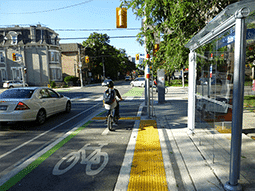
Even if the period during which bike lanes are open has lengthened over the years, we now need to move on to the next stage: transforming temporary sections of the network - those with bollards - into permanent sections, establishing coordinated snow-clearing policies between central administrations and the various boroughs, and using long-lasting markings to make bike lanes on streets that are theoretically clear during snow-clearing operations more visible.
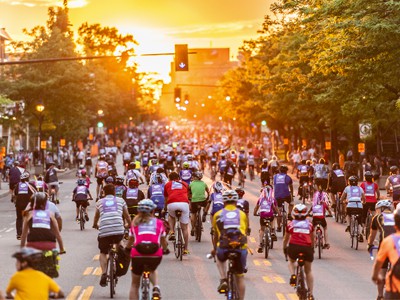
The need for a four-season cycling network is driven not only by milder seasons, but also by the ever-increasing number of cyclists on the network and on the streets of our cities. Take Montreal, for example. Between January 1 and November 1, 2012, there were some 1,080,000 cyclists on de Maisonneuve Boulevard. Other bike paths also saw a spectacular increase in ridership compared with 2011: note the one on Berri Street and Rachel Street, which saw growth of 29 % (920,000 cyclists in 2012) and 23 % (884,000 cyclists in 2012) respectively.
There are a growing number of examples of cities around the world carrying out winter maintenance on their cycle networks. The best-known examples come from Denmark, Norway and Sweden, but there are more and more in Canada and the United States, with Madison (WI), Calgary and, closer to home, Ottawa. Vélo Québec intends to propose to the City of Montreal an approach that would enable it to follow the example of several Nordic cities and gradually set up a four-season cycling network in Montreal.