







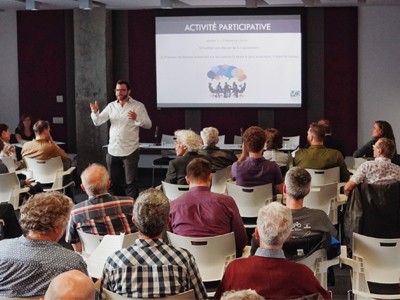



On May 23 and 24, Vélo Québec attended the consultation on the new sustainable mobility policy that the Quebec government intends to implement in 2014.
Vélo Québec reminded the government that the current land-use planning model, designed primarily for the car, is a costly model that has prevailed over the past fifty years, and one that our society can no longer afford to support. The staggering maintenance costs facing our governments today confirm this. And that's not counting the consequences in terms of traffic congestion and inefficient travel. The emission of pollutants harmful to health and the production of GHGs demand that we take action to turn things around. Time is running out!
Active transportation as a solution
Active transportation means cycling, of course, but also walking, and combining these two modes with public transit is an indispensable ally. If we are to succeed in reducing our dependence on the car, we need to be able to count on the benefits of combining active modes with public transit.
Investment in public and active transportation is the key to sustainable mobility. Maintaining current road infrastructures is a government responsibility. Increasing their capacity would be irresponsible for a government that is concerned about travel efficiency, wants to reduce its GHG emissions and is experiencing a crisis in public finances.
In Montreal, Quebec City and Gatineau, 1/3 of workers live within 5 km of their workplace. In cities like Trois-Rivières and Sherbrooke, 50 % live within 5 km of their workplace. Considering that 54 % of the Quebec population cycle, and that 37 % use their bikes for transport, it's obviously not far-fetched to think that cycling is an easy and inexpensive solution to the issue of urban mobility.
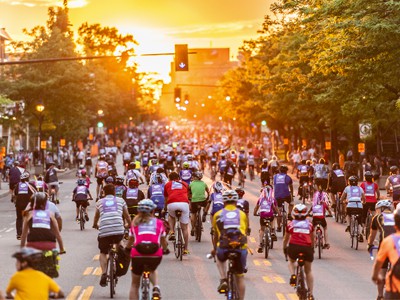
Montreal has become the cycling capital of North America, and the potential for growth is enormous. In Montreal, 53 % of cyclists use bicycles for transportation purposes: that's a quarter of the Montreal population. While the modal share of cycling is 2 % on the island of Montreal as a whole, in the central districts (600,000 residents) it exceeds 4 %, and in Le Plateau-Mont-Royal (100,000 residents) it exceeds 10 %. Imagine when the modal share of bicycles in Montreal's central districts reaches 15 %! That's an achievable goal within 10 years for Montreal, and a scalable one for the rest of Quebec.
Soothe the city!
- The main obstacle to walking and cycling is the number and speed of cars. Use your car, YES, use your car at all times and in all places, NO. Designing a favorable environment for pedestrians and cyclists requires time and money, but not much less than for roads and freeways, and above all political courage, because choices in favor of active transport must be accompanied by choices against the solo car.
Concrete measures to promote active transportation
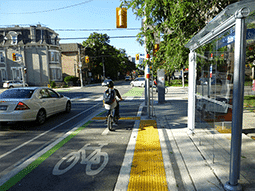
- Build bike lanes (lanes, paths, bike streets, priority two-way paths on one-way streets), safe bike parking facilities - in short, a coherent network that allows cyclists to get to employment centers, shopping streets and neighborhood institutions. The more lanes there are, the more cyclists there are - it's mathematical.
- The cost/benefit ratio of building bike lanes is so extraordinary that it's surprising that so little money is allocated to them each year, and that many municipalities cut their budgets when the axe falls.
- The Ministry of Transport must support cities in the investments required for land-use planning to encourage walking and cycling, and allocate substantial funds. The annual 8 M$ from the Green Fund added to the MTQ's Route verte investments is equivalent to 0.4 % of the MTQ's capital budget. In the Netherlands, 550 M$ were invested in 2012 by the government and cities to develop cycling infrastructure. The investments are paid 50 % by the cities, 50 % by the higher governments. Quebec has certainly invested steadily in cycling infrastructure over the past 25 years, mainly in recreational facilities. These investments are no stranger to the popularity of cycling in Quebec, and to the considerable lead we have over other North American provinces and states. But let's not stop just yet, when investments in more complex urban networks are needed to move more Quebecers from leisure cyclists to everyday cyclists.
- Municipalities should be required to draw up a sustainable mobility plan that includes cycling and walking, with quantified modal shift targets. Doubling the modal share of cycling is not an ambitious goal. But aiming to achieve 10 % to 15 % of bicycle trips within 10 years is a challenging goal that resembles the rates of inspiring northern European cities.Bicycles and public transit: a marriage of convenience
- The Ministry of Transport must demand a plan from transport companies so that they can implement all possible measures to increase complementarity between cycling and public transport. Examples: secure bicycle parking at bus terminals, train stations and metro stations; bicycle racks on buses (as on 85,000 buses in North America); improved bicycle transportation (capacity and schedule) on metro and commuter trains and ferries; development of reserved lanes for buses, cabs and bicycles. In short, public and active transportation offer efficient, low-cost travel opportunities.
- Bicycles and cabs: like some European countries, obliging cabs to equip themselves with bicycle racks so that they can carry bicycles would complete the chain of complementarity between bicycles and public transport.
Some additional ideas
- Revising the Highway Safety Code. The last major revision of the Code dates back to 1981. Since then, a number of reforms have helped to modernize the Code a little, but not to the extent required to take account of the reality of pedestrians and cyclists. In Europe, the "code de la rue" approach has made it possible to revise the highway code and give clear priority to pedestrians and cyclists.
- The self-service bicycle system has helped democratize the use of bicycles in cities. The case of Montreal is obvious, as it is in 500 other cities around the world. But Bixi's success was also due to the fact that Montreal's cycling culture was well established, and that a good network of bike paths made it easy to get around. But Bixi's financing issues have distracted attention from this public service, which we would like to see become profitable. Let's think of bike-sharing systems as public transport: it's a public transport offer whose benefits for the state are such that they justify the money we're pumping into it. Especially as the sums involved are minimal on the scale of public investment in transport.
- Offering a tax credit on the purchase of a bicycle for the first 500 $s would be a concrete gesture of assistance that the State can provide for the purchase of a bicycle. Between subsidizing an electric car and a bicycle, the choice is clear!
The MTQ has been shaping Quebec's landscape for 100 years. It has a direct role to play (with its developments and the incentive programs it puts forward) and an indirect role, through the link it can provide with all the other ministries and public agencies responsible for environmental quality, health and healthy lifestyles. It also plays a major role with regard to the municipal sector. We'll be keeping a close eye on the work being done on this policy, to ensure that Quebec enters the era of 21st-century travel, focused on the mobility of people rather than the mobility of cars.