










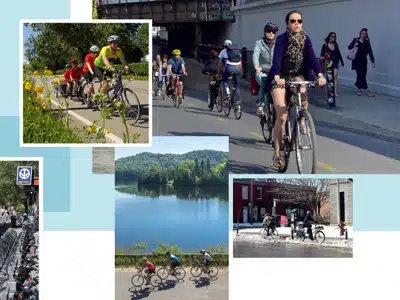
The election campaign that is now drawing to a close has been a painful one for those concerned with the development of cycling. With all the challenges facing municipalities, we should be delighted that cycling is doing well. However, throughout the campaign, candidates chose to use cycling to polarize and confuse the issue of our real collective mobility challenges. And that's very problematic.
Citizens are well ahead of their elected representatives. According to a recent Léger survey commissioned by Vivre en Ville, 77 % of Quebecers believe that it is important for municipalities to provide facilities that improve safety for pedestrians and cyclists. This clear and consistent social consensus reflects a desire for change: people have understood the immense value of living environments where it's safe and pleasant to get around in ways other than by car.
And with good reason: Quebec has made remarkable progress in recent years. In Montreal, the modal share of cycling has almost doubled, from from 6 % to 11 % in inner-city areas over five years. In Quebec City, the success of the àVélo bike-sharing service, which has smashed its annual targets every season since its launch, illustrates the extent to which people are ready to adopt this mode of transport as soon as they are given the means to do so. Citizens have changed their habits, now it's time for their elected representatives to do the same.
On the political front, however, things are moving too slowly. In this municipal campaign, many candidates are declaring themselves to be «pro-bike». Almost all of them claim to believe in the benefits of active transport, safe travel and the fight against climate change. But there's often a gulf between declarations of principle and concrete decisions.
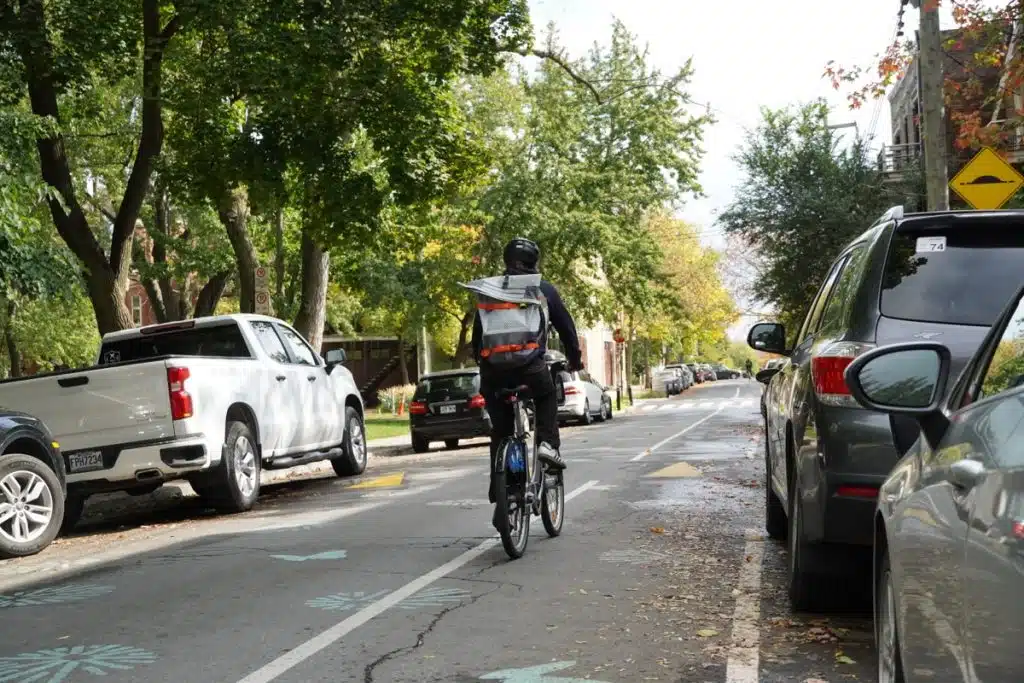
Being genuinely pro-bike isn't just about saying you love bikes. It means accepting that to make our streets safer and more welcoming for everyone, we sometimes need to rebalance public space, which means, yes, removing a few parking spaces or reallocating a lane for automobile traffic. It's about taking consistent action, not multiplying conditions that paralyze all action.
False support for bicycles can be recognized by certain arguments that come up again and again, and which, under the guise of common sense, amount to saying: «not here, not now».
- It is claimed that bicycle paths are not safe enough - as if the absence of development were a guarantee of safety. Yet the safety of undeveloped arterial roads, where the most serious collisions occur, is never questioned. This double standard speaks volumes about their priorities.
- It is said that it costs too much - while cycling investments are marginal on a municipal scale: in 2025, the City of Montreal invested 30 million for bicycle paths and 550 million for road infrastructure. Bicycle-related expenditure accounts for only 5 % of this budget. Against this backdrop, it's hard to argue that cycling is jeopardizing public finances.
- We say to ourselves bicycle-friendly, but not at the expense of parking - in other words, we'll never make one. In downtown Montreal, 36.5% of households don't own a car. The question is, on-street parking for whom?
- We still think that’there wasn't enough consultation - forgetting that you can't expect unanimity when you shake things up. The status quo, too, creates dissatisfaction. Today, in Montreal, cars take up 98 % of traffic space, compared with just 2 % for cycle paths. It's time to redress the balance.
- And more recently other priorities - homelessness, housing and water infrastructure, as if promoting safe, economical and environmentally-friendly travel were a luxury. In reality, these issues are not mutually exclusive: they are all linked to quality of life, public health and the attractiveness of our cities. What happened to our ability to walk and chew gum at the same time?
The best location is always elsewhere, the best time is always later, and there can never be enough consultation.
We can't wait for the end of this campaign, in which we collectively missed the opportunity to discuss how to develop cycling and how to support citizens in the necessary changes towards more diversified mobility. A campaign that instrumentalized seniors, families and people with reduced mobility, who nevertheless benefit greatly from cycling and pedestrian infrastructures, in order to defend on-street parking used by a minority.
Whatever the outcome of the Quebec campaigns, reality will catch up with the candidates. There's nothing exaggerated about the investments made in cycling in Quebec. Anyone who looks beyond prejudice and simplistic rhetoric will see that these investments remain modest. On the contrary, cycling is an under-exploited solution, and saying «we love cycling» won't be enough to make it a real solution for most people.
Cycling citizens and allies of Quebec, don't miss the opportunity to have your say on the future of your living environment. Get out and vote!
- Jean-François Rheault, CEO