

















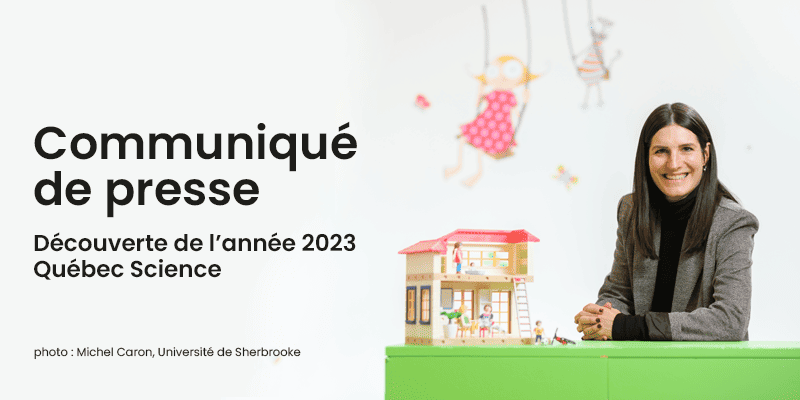
Montreal, March 18, 2024 - Every year for over 30 years, the magazine Québec Science brings together a jury of scientists and journalists to select the 10 most impressive Quebec discoveries of the past year. The public is then invited to vote for their favorite. This year, it was the discovery of Gabrielle Garon-Carrier, a professor in the Department of Psychoeducation at the Université de Sherbrooke, that won over the public. She demonstrates the benefits of long maternity leave on children's mental health, even when the leave results in a substantial drop in income.
Context
In Quebec, in most cases, parents are fortunate enough to be able to take several months off work to welcome their baby, while still receiving part of their salary. But for some families, this reduction in income can be hard to take. In such a case, what's less damaging for the child: keeping him or her at home for a long time and experiencing financial stress, or returning to work quickly? In their study published in July 2023 in the magazine Health Education and Behaviour, Professors Gabrielle Garon-Carrier and Caroline Fitzpatrick have shown that a leave of absence of more than 5 months significantly reduces the risk of developing separation anxiety in early childhood, even in the event of a precarious financial situation.
The study
Until now, very few studies have looked at the link between parental leave and children's well-being. The team surveyed over 1,295 Quebec families divided into three groups of mothers who, 5 months after the birth of their child, were either on maternity leave with no financial difficulties, on maternity leave and in a situation of economic precariousness, or had returned to work. The results show that children of mothers who were on leave when they were 5 months old had a lower level of separation anxiety between 17 months and 6 years than children whose mothers had returned to work.
A necessary validation
Quebec benefits from particularly flexible and generous parental leave, which is far from being the case everywhere. At a time when many nations are working to improve or evolve their own parental benefits, evidence-based data is essential. This type of study provides solid scientific arguments in support of the importance of maternity leave for child development,« says Marine Corniou, editor-in-chief of Québec Science. It's rare for a social science discovery to top the charts; I think this reflects the concerns of the public and confirms the relevance, for a magazine like ours, of also covering these issues.»
Keep up the momentum
This recognition by Québec Science has a definite impact on further work: «I plan to continue this study by examining in a more granular and refined way the contribution of parental leave (including paternal leave) to the mental health of parents and to the cognitive and mental health of young children,» says Professor Garon-Carrier.
In the short term (spring-summer 2024), she will be able to access administrative data from the Quebec Parental Insurance Plan, coupled with data from the Growing Up in Quebec survey (the Quebec Longitudinal Study of Child Development - 2nd edition), enabling her to draw up an initial portrait of parental leave user profiles (including a profile of non-users). No doubt we'll be on the lookout for more...
Also involved in this discovery were Arya Ansari of Ohio State University, USA, and Rachel Margolis of the University of Western Ontario.