








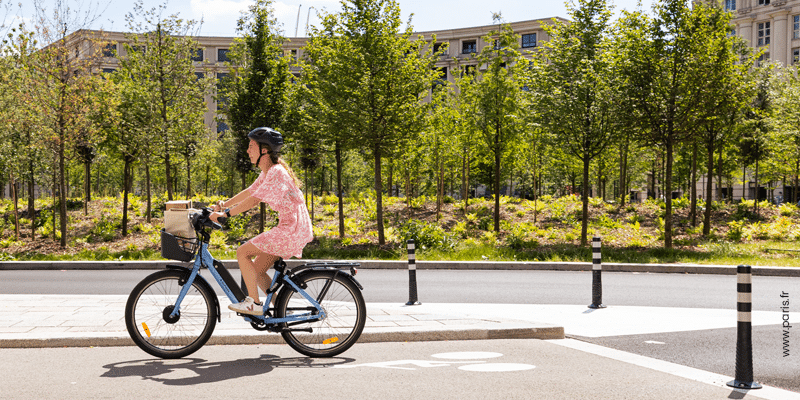
I remember my first visit in October 2005: discovering this monumental city with the exhilarating feeling of freedom that comes with cycling. I was discovering Paris on two wheels, exhilarating between the cars and buses. I also remember the launch of Vélib’ in July 2007 and the atmosphere it created. Before smartphones, we used paper maps to find the stations. Sometimes we'd come across an empty or full station, and we'd have to ask for directions. Suddenly, the bike became a link between people in the city. But also a tool that linked people TO THE city.
Since then, Paris has continued to evolve, and I was able to measure the full extent of this during my recent visit at the end of February, when I was invited by FUB to take part in their congress. FUB (Fédération des Usagers de la Bicyclette) is a French association set up in 1980 to promote cycling as an everyday mode of transport. Today, it brings together more than 500 local associations across France, all committed to improving cycling conditions. In recent years, under the leadership of outgoing president Olivier Schneider, FUB has done a remarkable job of implementing a series of ambitious programs to drive cycling forward. Their work is an inspiration to us at Vélo Québec.
For almost twenty years, Paris has been developing cycling to make it accessible to as many people as possible. But the last seven years have seen a real acceleration. For my part, I hadn't cycled in Paris for five years. I have to say that I was astounded by the quantity and quality of cycling facilities. Streets where cycling used to be difficult, like Lafayette, are now pleasant and efficient. I didn't even recognize Saint-Michel, so pleasant was it to ride. The intersection of Bonne-Nouvelle and Sébastopol has become child's play.
The most surprising thing for me was the disappearance of the huge traffic circle at Place de la Catalogne. Today, this once noisy and stressful space has been transformed into a vast pedestrian square adorned with 470 trees. Absolutely magnificent.
I particularly liked the new velorues in commercial zones. Created with the ambition of completely eliminating through-traffic, they offer an extremely pleasant living environment. The end of automobile transit allows shops to open up to the street. The atmosphere is completely transformed.
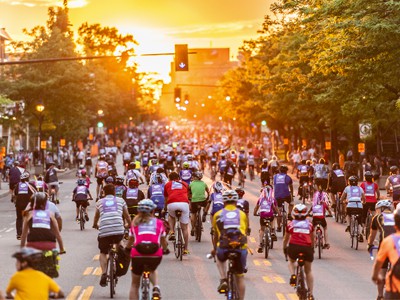
But what really touched my heart was to see Parisians of all ages choosing to get around by bike. Even in February, even in the rain. I met students in a hurry, workers in suits, parents accompanying their children, and older people peacefully enjoying their bike ride. I was moved by this diversity, as it is the true sign of a city that has succeeded in transforming its relationship with mobility. The moment I saw an old lady firmly challenge a deliveryman illegally parked on the cycle path, I realized that Paris had truly become a city of cyclists.
The new developments are remarkably pragmatic and creative. The 2023 and 2024 infrastructures are even better than those of 2019. The vision is clear and the City of Paris is moving forward without compromise in the face of criticism. And the results are fabulous: improved air quality, reduced noise, fewer collisions. Today, there are more people travel by bike than by car in Paris.
With humility and courage, the City of Paris has accomplished what everyone thought was impossible: to make Paris a great cycling city. No one believed in it, but Paris did it. Paris shows us that the wildest urban dreams can become reality. As we approach the next municipal elections in Quebec, who can embody a similar vision to transform their city?
Jean-François Rheault
President and CEO, Vélo Québec