When we navigate the streets on two wheels, we know that our safety rests partly in the hands of other road users who are bigger, faster and more dangerous than we are. We're all familiar with this feeling of insecurity: it can even make us give up riding our bikes.
But do we give enough thought to the impact of our own cycling behaviour? To the safety - real and perceived - of users even less protected and more vulnerable than ourselves?
A philosophy to apply: the precautionary principle
DID YOU KNOW?
Since 2018, the Road Safety Code includes, in its preamble, a principle of prudence, which states that :
«Every road user is duty bound, especially towards those who are more vulnerable than he is, It is the responsibility of all motorists to act with caution and respect when using public roads. [...] »
Respecting vulnerable road users when cycling means :
Do not drive on sidewalks or other pedestrian areas, except when authorized by signs. In such cases, reduce speed and give way to pedestrians.
In shared spaces (multi-purpose trails), reduce speed and signal your presence to avoid surprising pedestrians. No bell? Simply use your voice to signal your presence!
The Highway Safety Code prohibits cyclists from riding on sidewalks:
« 492.1. A cyclist may not ride on a sidewalk, except in case of necessity or unless signs prescribe or allow it. They must then travel at a reasonable and prudent speed and give priority to pedestrians.»
Special care for the most vulnerable
Veiller aux plus vulnérables, c'est aussi tenir compte users with special needs: the children unpredictable behaviour, the seniors more fragile blind or partially sighted people that have trouble detecting our presence, the hearing-impaired people that could be taken by surprise, or any other people with functional limitations.
TESTIMONIAL
« We can't see you and it's hard to hear you, especially when it's noisier. So we don't know when you're there or when you're arriving. »
Nathalie Chartrand, blind person using a guide dog and member of the Regroupement des aveugles et amblyopes du Montréal métropolitain (RAAMM).
DID YOU KNOW?
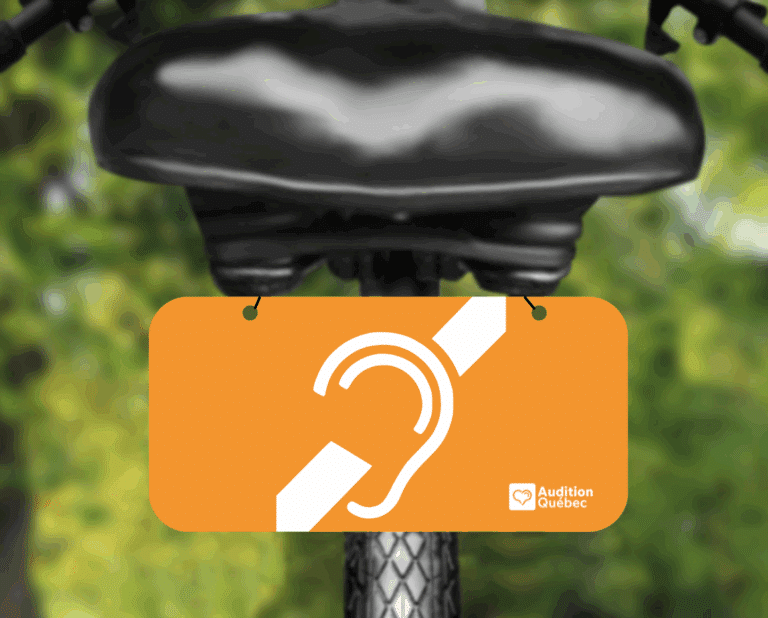
This symbol indicates a hearing-impaired person.
When approaching it, be extra vigilant and allow plenty of space for overtaking.
For more information and to purchase a plate for hearing-impaired cyclists, visit Audition Québec website.
5 situations where pedestrians have priority
AT CROSSWALKS
Key message: «On my bike, I stop as soon as a pedestrian is about to cross at a crosswalk or intersection.»
In Quebec, there are two types of crosswalks:
Visit controlled passages by a stop sign or traffic light, accompanied by ground markings in the form of parallel white lines or white blocks;
DID YOU KNOW?
Since 2018, the Highway Safety Code authorizes cyclists to cross during the pedestrian phase of traffic lights, If you have to stop beforehand and give way to pedestrians:
« 359. Unless otherwise indicated, when faced with a red light, the driver of a road vehicle or a cyclist must stop his vehicle before the crosswalk or the stop line [...].
Notwithstanding the first paragraph and unless otherwise indicated, a cyclist facing a pedestrian light at a red traffic light may continue on his route. However, it must come to a standstill before the crosswalk or stop line [...] and ensure that it is safe to do so. He must then proceed at a reasonable and prudent speed and give priority to pedestrians. [...] »
Visit uncontrolled passages, This is a pedestrian-free zone, where motorists and cyclists are obliged to stop whenever a pedestrian is about to cross.
DID YOU KNOW?
The Highway Safety Code stipulates that both cyclists and motorists must stop and give way. when a pedestrian indicates his intention to cross the road :
« 410. When a pedestrian enters or indicates his intention to enter a crosswalk, the driver of a road vehicle must stop his vehicle to allow the pedestrian to cross. At such a crossing, the cyclist must also give way to pedestrians.»
In both cases, on a bicycle, you must stop and wait for the pedestrian to complete the crossing. Never assume that you'll have time to get in front of or behind a pedestrian by anticipating their trajectory: it can be unpredictable, and no one likes to be brushed!
AT THE BUS STOP
Key message: «On my bike, I stop as soon as the bus stops, then let the passengers on and off.»
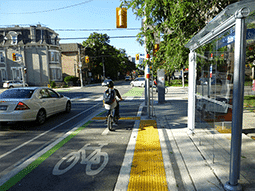
In recent years, cycling infrastructure has been improved to reduce the risk of conflicts and collisions between cyclists and buses on streets with both a cycle lane and a bus route.
In the past, bike lanes disappeared around bus stops to allow buses to fold up along the sidewalk, but now «bike lanes" have been added.« floating bus stops »These "universally accessible" solutions are now available.
Source : card developed by the OPCM in collaboration with the Comité consultatif en accessibilité universelle (CCAU) and the STM.
At such bus stops, passengers must cross the bike path, which is raised to sidewalk level, in order to board or disembark buses.
When approaching these stops, cyclists must therefore redouble your vigilance, slow down and be ready to stop and give way public transit users.
IN FRONT OF A SCHOOL BUS
Key message: «On my bike, I come to a stop more than 5 meters from a school bus with the stop sign deployed.»
When a school bus stops, deploys its stop sign and activates its flashing lights, it's clear: a child is about to get on or off the bus.
TESTIMONIAL
« You have to understand that children are very unpredictable; they're so anxious to see their parents, it's hard to hold them back. We do our best to check everything before opening the bus door, but cyclists really have to stop to let children disembark safely. »
- Danny Martel, bus driver, Transco
What should be a simple rule of courtesy and common sense for cyclists is now written in black and white: even on a bicycle, you must stop more than 5 metres from the bus in such a situation.
DID YOU KNOW?
Since 2018, the Highway Safety Code specifies the cyclist's obligations:
« 460. The driver of a road vehicle or a cyclist approaching a bus or minibus used to transport schoolchildren when its intermittent red lights are on or when its mandatory stop signal is in use must stop his vehicle more than 5 metres from the bus or minibus and may only pass or overtake it when the intermittent red lights are off and the mandatory stop sign is retracted, and only after ensuring that it is safe to do so.
The first paragraph does not apply to a driver of a road vehicle and a cyclist when they pass a bus or minibus assigned to transport schoolchildren on an adjacent roadway separated by a median or other raised physical device.»
FACING A SCHOOL CROSSING GUARD
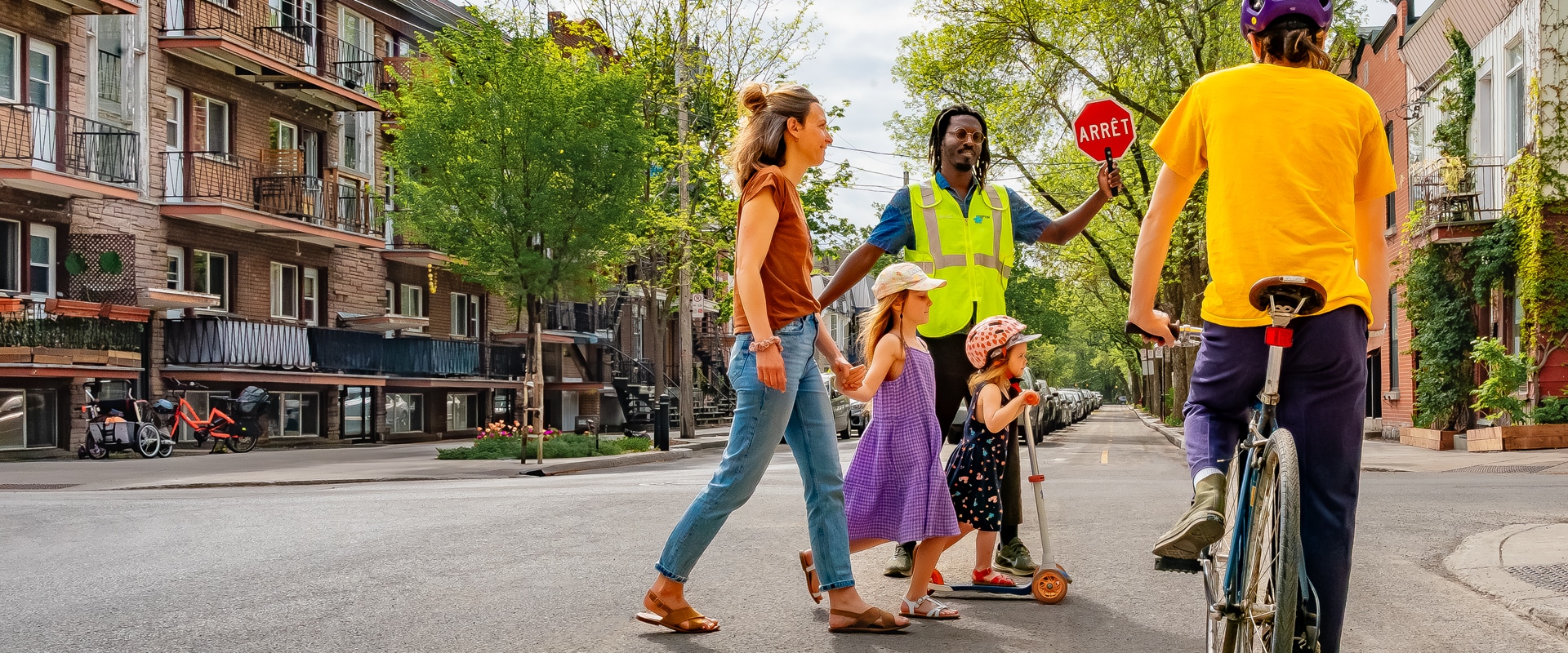
Key message «On my bike, I stop when the crossing guard's stop sign is up.»
When a crossing guard enters an intersection with his or her stop sign raised, the signal is clear: a child or small family is about to cross. This is not the time to accelerate to get ahead or behind them; children can be so unpredictable!
TESTIMONIAL
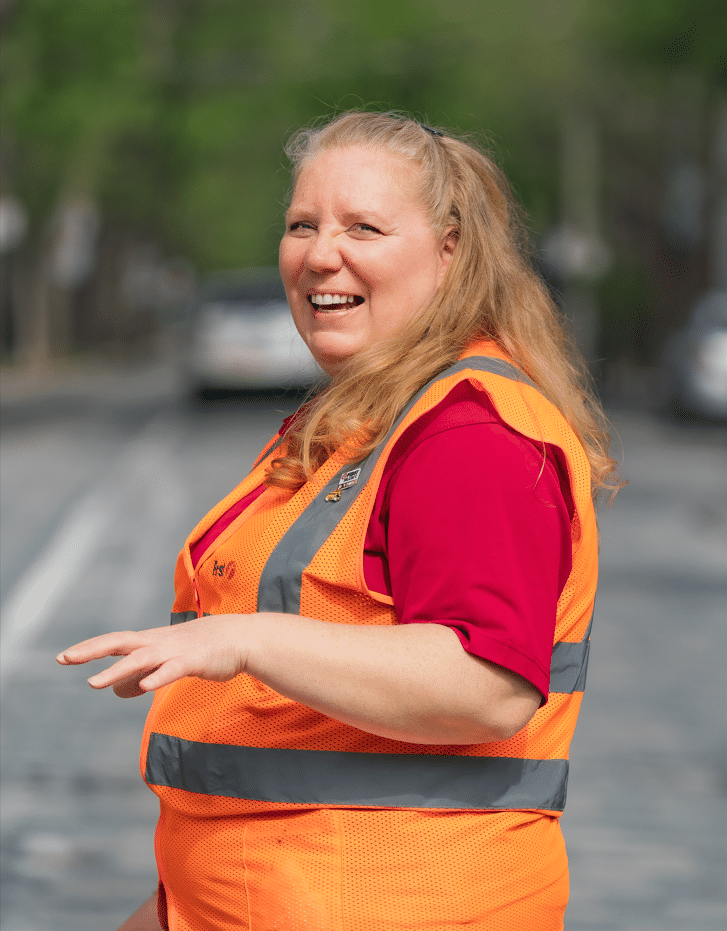
« As a school crossing guard, I witness risky behavior by some cyclists in our school zones every day. There's no merit in slaloming between parents and children. It's not only dangerous, it creates unnecessary stress for everyone. Think of the elderly, parents with strollers, children just learning to ride a bike.
It's not just a question of safety - although the safety of pedestrians and our students should be enough to make us stop. It's also a question of courtesy and living together. When cyclists don't slow down at stops, what kind of example are they setting for local youngsters? Knowing how to stop goes deeper than you might think. It's a simple but meaningful gesture. In a society that values speed, each and every one of us, in our own way, can contribute to making our neighborhoods safer, friendlier, more human places.»
- Malcom, school crossing guard, filmmaker and painter
Obeying a crossing guard's mandatory stop is more than just a courtesy: it's an obligation.
DID YOU KNOW?
Brigadiers' instructions take precedence over signs for all road users:
« 311. When the traffic is directed by a peace officer, a school crossing guard or a signaller in charge of directing traffic during roadworks, exceptional events or sports competitions, everyone must, despite signs to the contrary, obey their orders and signals. »
ON A PEDESTRIANIZED SHOPPING STREET ALLOWING CYCLISTS
Key message: «On a pedestrianized shopping street where cyclists are allowed, I ride my bike at walking pace and keep my distance. If need be, I get off my bike and walk.»
During the summer season, a growing number of shopping streets become pedestrianized, to the delight of residents who stroll along and enjoy the terraces. On some streets, cyclists are required to disembark.
DID YOU KNOW?
The green circle on this sign indicates an obligation: to get off your bike.
Many pedestrianized streets have such an obligation. In such cases, there's no choice but to walk alongside your bike.
Other streets tolerate the presence of cyclists, provided they adapt their speed to that of pedestrians and give them ample space. And when the crowds of pedestrians get too dense, we use common sense: we get off our bikes and walk alongside, for everyone's comfort and safety.
TESTIMONIAL
« We believe that a pedestrian street is a collective space intended for all users, and it's in this spirit of cohabitation that Mont-Royal Avenue welcomes cyclists, while remembering that pedestrians and people with functional limitations remain the priority.»
- Claude Rainville, General Manager, Société de développement de l'Avenue du Mont-Royal


















 « We believe that a pedestrian street is a collective space intended for all users, and it's in this spirit of cohabitation that Mont-Royal Avenue welcomes cyclists, while remembering that pedestrians and people with functional limitations remain the priority.»