



















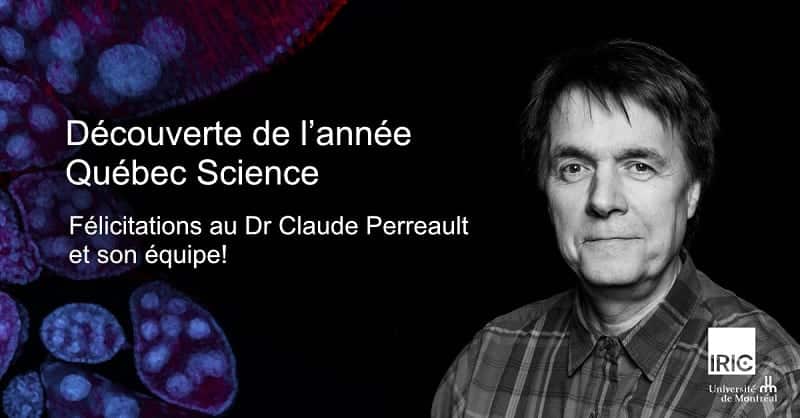
Montréal, May 14, 2020 - For 27 years Québec Science continues the tradition: every autumn, a jury of researchers and journalists selects the 10 most impressive Quebec discoveries of the past year, and the public is then invited to vote for the one of their choice. This year, it was a novel method for producing vaccines capable of treating certain cancers that won the readers' favor, with 40 % of the votes cast in the 2019 Discoveries of the Year competition.
For decades, the quest for a cancer vaccine has been fruitless, but a team from the Institute for Research in Immunology and Cancer (IRIC) at the Université de Montréal has managed to change all that by delving into «junk DNA». This nickname is attributed to over 90 % of our DNA, on the pretext that this genetic material doesn't code for any proteins. But the Dr Claude Perreault and his colleagues have found in these misunderstood DNA sequences the ingredient for a unique therapy.
Any vaccine must provide the immune system with a clear target. This target is antigens, fragments of protein present on the surface of cells. It is thanks to them that specialized immune cells, the T lymphocytes, recognize and eliminate diseased cells. However, cancer cells have few antigens that can be detected by T lymphocytes, so they remain undetected and proliferate.
The Dr Perreault systematically studied all the antigens present on normal and cancer cells, and then identified the differences between the two: the so-called «cancer-specific» antigens. This colossal task revealed that the vast majority of cancer-specific antigens come from junk DNA. They could serve as targets for several patients with the same type of cancer. In mice, the results are promising: some of the vaccines tested cured all the rodents. Never before seen!
To develop a first-in-human vaccine, researchers are focusing on ovarian cancer and acute myeloid leukemia. In this respect, a recent breakthrough has demonstrated that cancer-specific antigens are found in virtually all ovarian cancer tumors, and are widely shared between them. Clinical studies will be launched within the next three years. If they prove conclusive, thousands of patients will one day see their lives transformed.
«My team and I are extremely grateful that our work has been named Scientific Discovery of the Year 2019 by Québec Science. We will continue to honour this distinction by pursuing our objectives, with a view to changing the lives of people affected by cancer. We would like to thank all those who have contributed to the advancement of our research project, and who have had faith in our audacity to approach research differently. It is together that we will one day succeed in taming this scourge», declared Dr Perreault, Senior Researcher at IRIC.
«When IRIC was created on the Université de Montréal campus in 2003, we were firmly convinced that, thanks to its unique model combining basic research activities, a university training program and a team translating discoveries into therapeutic solutions under one roof, our researchers would provide crucial answers to our understanding of cancer and its treatment,» said Université de Montréal Rector Guy Breton. «Today, we have further proof that our hopes are shared by many Quebecers.»
«Cancer touches us all in one way or another. This public vote embodies the importance that the fight against cancer has acquired in our society. It's also a tribute to the ability of our researchers to innovate and push back the boundaries, time and time again,» said the editor-in-chief of Québec Science, Marie Lambert-Chan.
Also participating in the discovery: Céline Laumont, Krystel Vincent, Leslie Hesnard, Éric Audemard, Éric Bonneil, Jean-Philippe Laverdure, Patrick Gendron, Mathieu Courcelles, Marie-Pierre Hardy, Caroline Côté, Chantal Durette, Charles St-Pierre, Mohamed Benhammadi, Joël Lanoix, Sébastien Lemieux and Pierre Thibault, from IRIC, and Elie Haddad and Suzanne Vobecky, from CHU Sainte-Justine.