
















Montreal, December 8, 2017 - Vélo Québec welcomes the introduction of the bill to modernize the Road Safety Code announced today by the Minister of Transport, Sustainable Mobility and Transportation Electrification (MTMDET), André Fortin. Vélo Québec is delighted that this modernized Code lays the foundations for a necessary paradigm shift, and sees promising prospects for the future.
A welcome change of philosophy
With the introduction of a precautionary principle in the preamble to the new Code, the unanimous appeals of Vélo Québec and other cycling and pedestrian groups have been heard. This principle, which recognizes the vulnerability of certain users and the increased responsibility of drivers of vehicles and heavy goods vehicles, will now have to be reflected in everyone's daily life, in the types of facilities, the education of road users, regulations and their enforcement by police services.
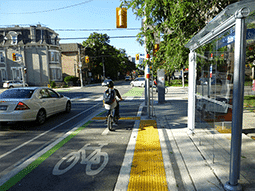
Vélo Québec also welcomes the new provisions to regularize the creation of bike lanes and shared streets in Quebec municipalities. «The bill recognizes that streets are more than just tunnels for moving vehicles; they are also home to forms of mobility on a human scale,» says Suzanne Lareau, President and CEO of Vélo Québec. «These provisions will help create new spaces that offer a better balance between local life and traffic.
Adapting to cyclists' realities
The new Code also finally adapts to the contemporary reality of cycling, putting an end to a long-criticized inequity by abolishing demerit points for certain cycling offences. On the other hand, the increase in fines is substantial! Vélo Québec has always advocated penalties proportionate to the danger to others. While the announced increase in fines may be justified for dangerous cycling behavior, in other cases Vélo Québec considers them far too high.
«In concrete terms, this means that you could be fined from 80$ to 100$ for slowing down significantly, without coming to a complete stop, at a stop sign; or for using a pedestrian light to leave an intersection,» illustrates Suzanne Lareau. «We find it hard to understand why our proposals to allow cyclists to treat stops as yield signs, or to cross intersections using pedestrian lights, have not been adopted.» These practices, already widespread, were also put forward by the City of Montreal, one of the cities with the highest number of bicycle trips, not only in Quebec, but in North America. The use of the pedestrian light alone provides cyclists with a gain in terms of safety, by enabling them to leave the intersection before cars and heavy vehicles.
A work in progress
After the adoption of two flagship measures in favor of cyclists in the spring of 2016 (passing distance and penalties for impeding), a new milestone has been reached with the introduction of this bill. But for Vélo Québec, the work is far from over. We intend to continue our work with the government,« continues Suzanne Lareau, »and to work with municipalities wishing to carry out pilot projects to propose documented experiences that will pave the way for future measures in favor of cyclists. Finally, to take more direct account of changing practices, we would like the government to adopt a legislative mechanism that would enable the Code to be revised on an ongoing basis.