




















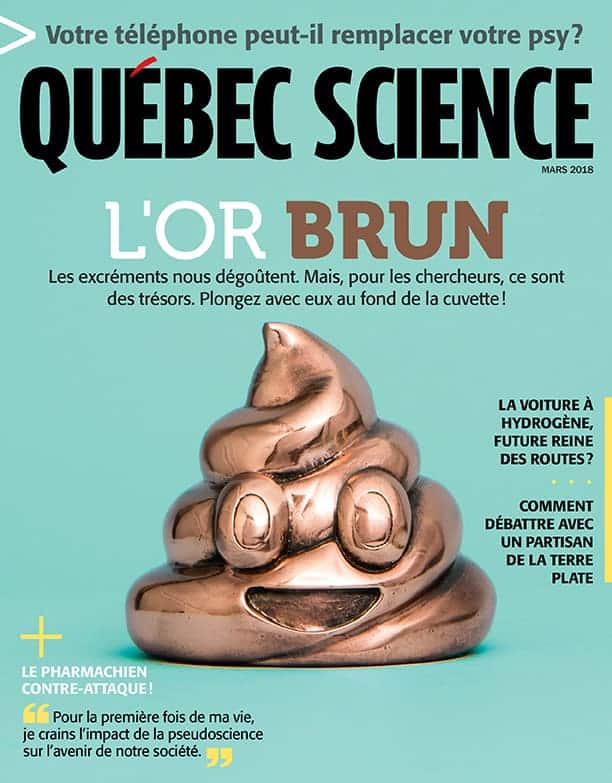
Montreal, Thursday, February 15, 2018 - Excrement disgusts, embarrasses and sometimes inspires a few dubious jokes... But for scientists, it's a veritable treasure trove. A source of medicines and energy, they open an unprecedented window onto human intestinal microbiota and animal behavior. In its latest issue, on newsstands now, Québec Science has a special feature on brown gold!
Stool, the new medicine
For the past five years, fecal transplants have been working miracles in hospitals against Clostridium Difficile bacterial infection. So much so, in fact, that researchers are considering its use against other disorders, such as autism, Alzheimer's and obesity.
Fifty shades of brown
How much does the appearance of our stools reflect our state of health? Journalist Marianne Desautels-Marissal takes a look with Sacha Sidani, gastroenterologist at the Centre hospitalier de l'Université de Montréal: «In terms of color, odor, shape and frequency, there is no such thing as a normal or ideal stool.»
The second life of excrement
You'd think that human faeces, once evacuated, would have no further use. However, researchers are working hard to reuse this brown matter, which is far from being synonymous with waste: «We should stop seeing excrement as waste. It's a free source of energy, much greener than oil,» stresses Catherine Bourgault, a doctoral student in water engineering at Laval University, whom the Québec Science team met.
Convincing faeces
Biologists will stop at nothing to study animal populations, even if it means using a nose-clipper! Droppings, guanos and faeces of all kinds are real treasures for those who know how to make them talk. Clues that tell us a great deal about the fauna and health of ecosystems, and even reveal certain details about the evolution of the climate.