










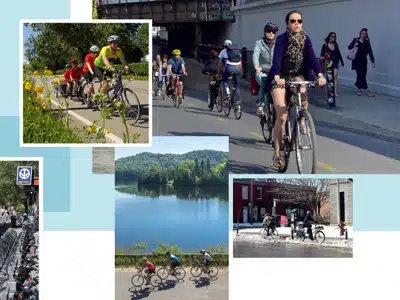
On June 28, I had the pleasure and honor of being invited to the inauguration of the new Samuel-de-Champlain Bridge, linking Montreal and the South Shore. Everything about that day was impressive. First and foremost, the infrastructure itself. The old bridge next door looks like a Meccano toy! Then there was the sheer number of dignitaries: ministers, elected municipal officials, metropolitan transport organizers, the whole transportation planet was there. But what impressed me the most was the importance given in the speeches to the fact that this bridge included a bicycle lane, which, what's more, will be accessible twelve months a year. And this from both the federal Minister of Infrastructure, François-Philippe Champagne, and the Quebec Minister of Transport, François Bonnardel. «A bridge, a runway: we're there,» said Minister Bonnardel, without hesitation. Music to my ears...
In our daily efforts to integrate cycling into transport infrastructures, we sometimes feel that we're treading water. Well, on June 28, I noticed that the tide seems to be turning. When the Île-aux-Tourtes bridge (on the west side of Montreal Island) is rebuilt in the near future, it will feature an exclusive bicycle lane. The same goes for the Pie-IX bridge, where renovation work has already begun. In Ontario, the Gordie-Howe International Bridge, which will link the two auto cities of Windsor and Detroit, will also include a bike lane! This puts an end to an era when this type of concept was not even part of the preliminary discussions.
So we're currently living at a time when many bridges are reaching the end of their useful lives. While progress is inevitably being made in both rhetoric and reality, this does not mean that the future is without challenges. We have proof of this with the famous Turcot park slab, initially planned by the Ministère des Transports (MTQ), then quietly withdrawn from the plans. After an impressive mobilization of the Montreal community, the subject was the subject of a preliminary agreement between Montreal and Quebec City before the 2017 provincial elections, but announcements from the current government are still pending... At the time of writing, the case of the Monseigneur-Langlois bridge had still not been settled, either. This MTQ bridge is intended to replace the Route verte regional bicycle link over the Beauharnois dam, which will be affected by work over a ten-year period. Although the bridge belongs to the MTQ, the project involves Hydro-Québec and the two MRCs (Beauharnois-Salaberry and Vaudreuil-Soulanges) that manage the regional cycling network. Hydro-Québec is acting as a good corporate citizen, financing a large part of the 1.6 M$ required over 10 years to make the crossing safe. The MTQ, after being approached by local cycling clubs and Vélo Québec, is increasing its contribution. As for the two MRCs, they have to share the balance (around 15,000 $ annually each), which we hope will be settled quickly. However, when the dust settles, the MTQ will have to take stock and reiterate its full responsibility when a cycle route, especially Route verte, uses its network or infrastructure. A road is a road. Whether you use it by car, on foot or by bike, the road manager should take account of the different uses and bear the costs. Just goes to show that not everything can be taken for granted!
Suzanne Lareau
President and General Manager