











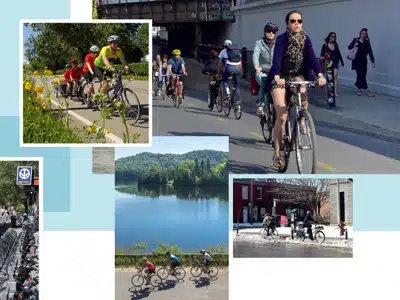
In February, I'll be leaving Vélo Québec after 35 years with the organization, including 20 as CEO. When I look at the current state of cycling in Quebec, I tell myself we've come a long way together!
The evolution of bicycle use in Quebec is not solely attributable to the work of Vélo Québec, but I firmly believe that our tenacity and determination to make a difference have helped change the face of cycling in Quebec. Concrete achievements such as the adoption of a cycling policy by the Quebec government (asphalting the shoulders of provincial highways, creation of the Route verte national cycling network, support for municipalities developing bike lanes, reform of the Highway Safety Code to take cyclists' realities into account, etc.); the organization of colloquia on the subject of cycling and the development of a national cycling network.); the organization of symposia and conferences to equip all entities that can contribute to the development of cycling; the support and defense of cyclists' interests to ensure their safety; the deployment of educational programs in schools to train the cyclists of tomorrow; the organization of events and trips to encourage cycling - these are all achievements that make me proud of the progress made by Vélo Québec and, above all, to see that more than half of all Quebecers now cycle! This is great news, considering that this figure was known long before the last cycling boom linked to the pandemic!
Today, Quebec is by far the most cycling-friendly province in Canada. Montreal's large cycling community has enabled the city to distinguish itself as Canada's cycling metropolis, while at the same time boasting the best cycling record of any major city, including Toronto, Vancouver and Calgary. I'd never say mission accomplished, since many issues and challenges remain. Among them, cyclists' safety must always be at the top of the agenda if we are to increase cycling. In this respect, the strategy adopted in Quebec by the government, its municipalities and its bicycle entrepreneurs is encouraging and bearing fruit: by offering cycling-friendly environments, Quebec has succeeded in creating a cycling culture that is the envy of other Canadian provinces and is reflected positively in our road balance.
Another challenge facing cities the world over is to make more room for bicycles in the city. To promote sustainable mobility and improve quality of life for all, we need to reduce the number of cars in the city. It's not ideological, as some people like to say, it's mathematical! Building safe bicycle lanes for everyone... takes space, and that space is the one we've left to the car over the decades.
At the end of this month, I'll be handing over the reins of Vélo Québec to Jean-François Rheault, a newcomer to the organization, but not to the world of cycling. For the past 15 years, Jean-François has worked for Éco-compteur, a company that installs, compiles and publishes statistics on walking and cycling in many of the world's cities. A seasoned urban cyclist and keen observer of cycling issues on five continents, he knows the importance of data in advancing a cause and overcoming prejudice. Behind every CEO is a team, and the Vélo Québec team is solid, competent and passionate. So it's in this stimulating environment, and with complete confidence, that I'm handing over the helm to him on January 1.er February. Jean-François will then be able to count on my full cooperation to help him get started in his new role.
I'm leaving Vélo Québec in February, but cycling will always be at the heart of my life.
Suzanne Lareau
President and General Manager