ON THE ROAD, OUR SAFETY
IS LINKED TO THAT OF OTHER
Share
At Vélo Québec, safety is at the heart of our concerns, and we take action on all fronts to ensure that everyone can cycle with complete peace of mind. Alongside our efforts to obtain better cycling infrastructure, a Road Safety Code adapted to cycling and more harmonious cohabitation with heavy vehicles, we believe that cyclists, through their behavior, are also part of the solution. Because on the road, our safety is linked to that of others.
8 GOOD CYCLING PRACTICES TO ADOPT!
For safer driving and better road sharing
Be visible at night
Reflectors and lights are mandatory, but above all indispensable. You can't ask others to look out for you if you're not visible!
Make sure you have the right reflectors and lights at all times:
White front reflector, red rear reflector;
Yellow or white reflector in front wheel (reflective strips on fork, rim or tire also accepted);
Red or white reflector in rear wheel (reflective strips on shrouds, rim or tire also accepted);
Yellow reflectors on pedals (reflective strips on shoes or around ankles also accepted);
White headlight at the front and red light at the rear when it's dark.
Avoiding blind spots
Drivers of heavy vehicles have to deal with very large blind spots. So it's vital to remain visible at all times, because if you can't see the driver in his rearview mirror or through the window, he can't see you either. Be vigilant and make sure you :
Never stand between the truck and the sidewalk;
Never overtake a truck unless it is stopped with its hazard warning lights on;
Make eye contact with the driver;
Remain at the rear of the truck when stopped.
Respect red lights
To avoid collisions, all road users must obey traffic lights at all times. A red light is red for everyone!
As of April 18, 2019, when faced with a red light and an activated pedestrian light, you will be authorized to continue on your route, and this, after coming to a halt and giving priority to pedestrians. If there are bicycle lights at intersections, these will prevail.
Giving way to buses
With several dozen passengers on board, it makes sense to give buses priority on the road. And since buses have to deal with very large blind spots, it's important to observe certain safety rules, such as :
Never stand between the bus and the sidewalk;
Make eye contact with the driver;
Make sure you are clearly seen by the driver.
Make eye contact at intersections
Make sure you're seen by other road users - cyclists, pedestrians, motorists, etc. - by making eye contact with them. - by making eye contact with them.
At red lights, position yourself in front of cars waiting for the green light, without encroaching on the crosswalk. You'll be clearly visible to stopped motorists. Be extra careful at intersections where turning right on a red light is permitted.
Courtesy and communication save a lot of altercations!
Adapt your speed to your environment
Adapting your speed allows you to interact with other road users and react to unexpected situations, maximizing safety for all.
Particularly in urban environments, where interactions between road users multiply, driving too fast can leave you vulnerable.
Always pass on the left
To overtake another cyclist - or a double-parked car - you must signal your intention and overtake on the left:
Look behind you to see if a car or bike is coming;
Signal with your arm to announce your intention to move to the left, then double;
You can also verbally announce your intention by saying «cyclist on the left» to the person you are overtaking.
Follow the direction of traffic
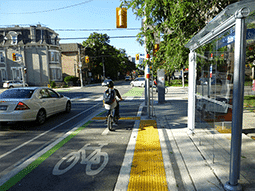
It is imperative to drive in the direction of traffic. Ride on the right on two-way lanes. On one-way cycle lanes and designated roadways, follow the direction of the chevrons. The arrows on the ground indicate the direction to follow.
When the roadway is not equipped with a bicycle lane, you must ride in the direction of vehicular traffic, unless the signs authorize contra-flow traffic for cyclists.
See the toolbox »
Join Vélo Québec in promoting good cycling practices in your network. Use the campaign tools - a video message, 6-second animations, a poster, visuals for your Facebook and Twitter communications - and take action!