











Mountain biking explained

Mountain biking is divided into three families - Cross-country, Enduro and Downhill. - each with its own speciality.

All three are cycled on natural-surface trails of varying levels of difficulty. The fundamental difference lies in experience and type of effort. At Cross-country and in Enduro, the uphill part(s) of the route are taken on by the cyclist, whereas in Downhill, They are carried out by ski lift. As for the level of difficulty of the descents, the practice Downhill is the most difficult, although some Enduro offer similar levels of difficulty. For all types of practice, it's always advisable to do a reconnaissance (i.e. take the trail at low speed), to get a feel for the layout and condition of the trail.

Cross-country

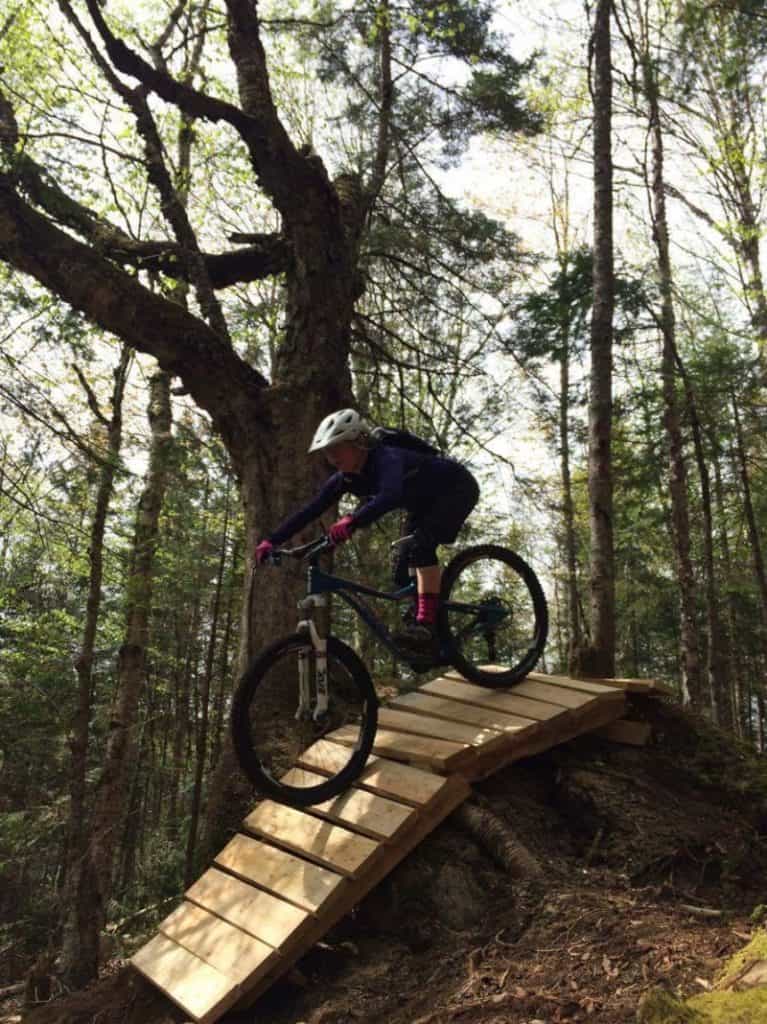
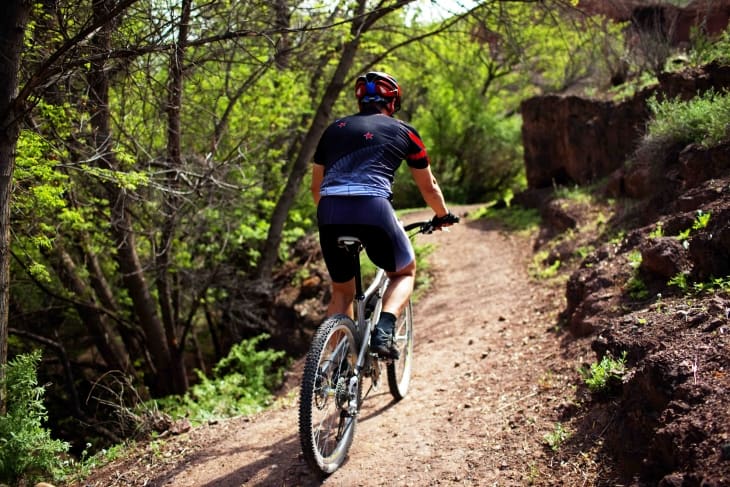
The most widespread mountain biking sport, accessible to men, women and children, cross-country involves riding on narrow, unpaved trails with many curves and variations in level. Trail difficulty ranges from very easy to very difficult.

Cross-country enthusiasts use their own means to traverse the trail across the mountain, much like cross-country skiers.

Cross-country has been an Olympic discipline since the 1996 Atlanta Olympic Games.
Equipment used

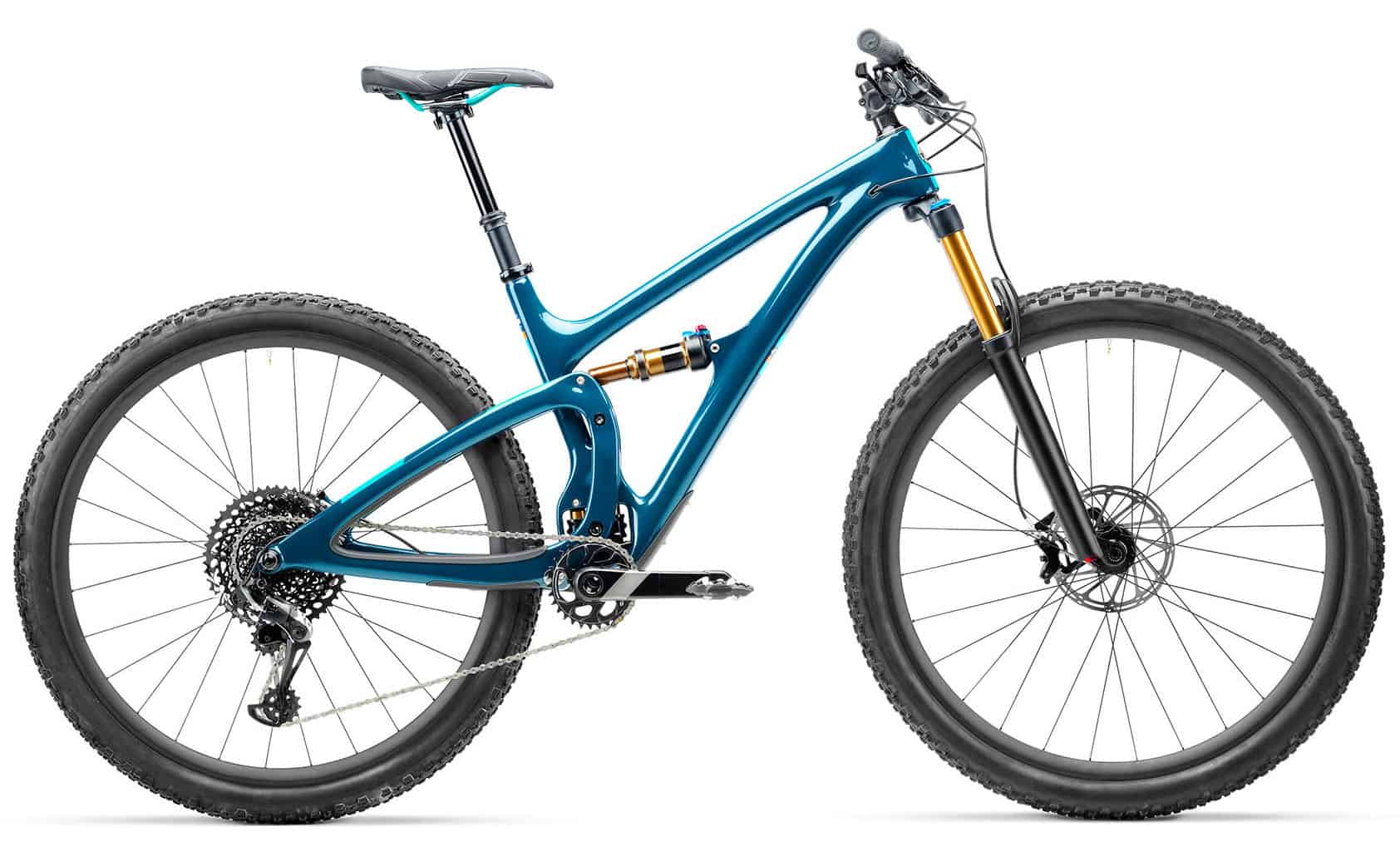
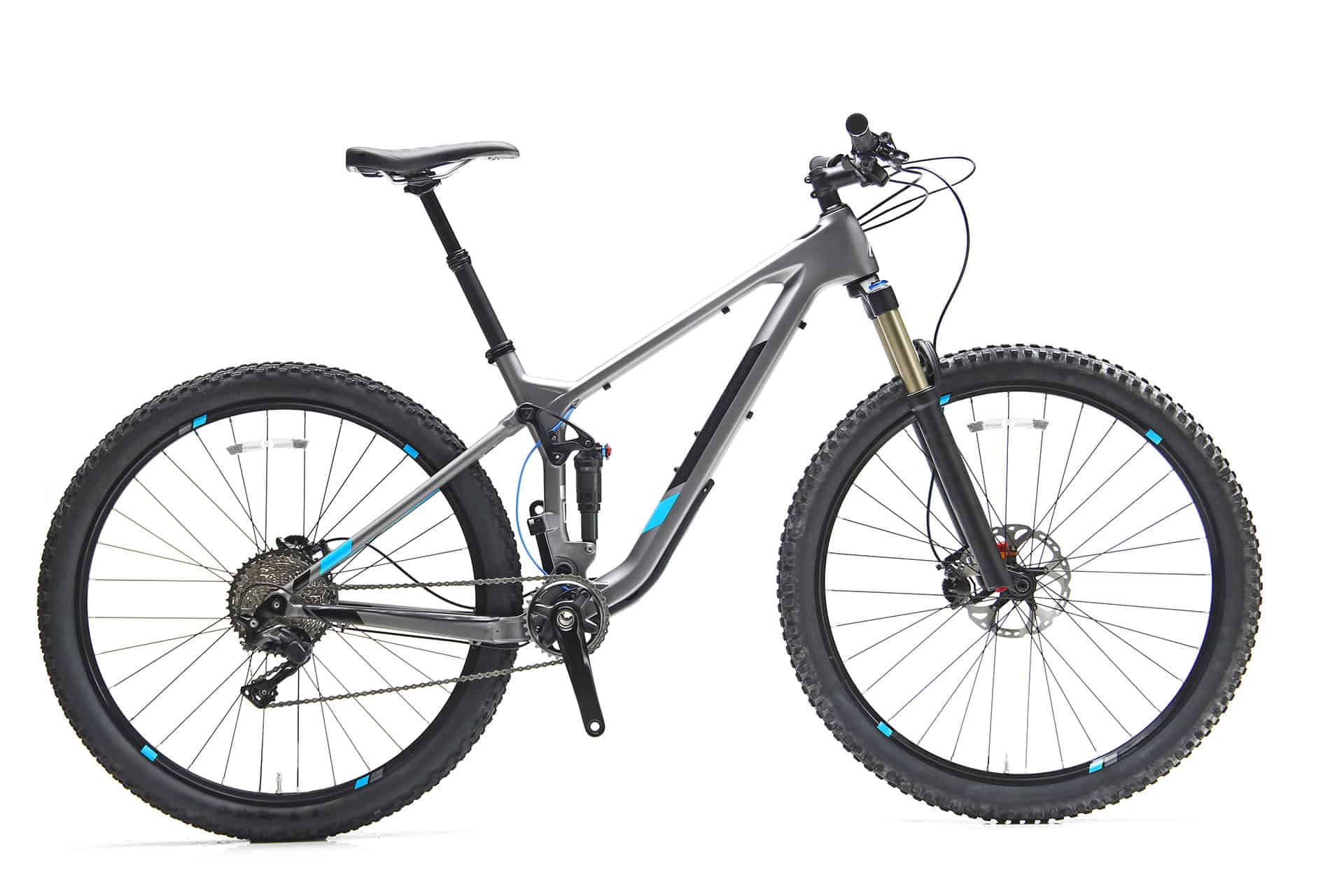
Cross-country riding is practiced with a lightweight bike featuring front or full suspension (front and rear) with short travel (usually around 100 to 130 mm front and rear) to absorb trail irregularities without hindering pedaling. Frame angles are usually designed to facilitate efficient pedaling, especially uphill.

In addition to comfort, suspension enhances performance by enabling you to overcome obstacles more quickly than with a bike without it. Studded tires in a variety of profiles provide grip on soft ground or in wet conditions.

The trails

The emergence of beginner trails and bike parks in recent years has enabled rapid progress in the skills needed for trail riding.

Visit trail difficulty is expressed using the pictograms used for downhill skiing and other activities and is determined according to:

  • trail width
  • the characteristics of the trail's running surface
  • length and inclination of slopes
  • the size of obstacles on the .

Although the majority of mountain biking areas require a mountain (to take advantage of its gradient), some trails are built on terrain with little gradient, which in no way hinders the practice of cross-country biking. Trails are sometimes upgraded with features designed to enhance the cyclist's experience, whether by creating gradients or adding obstacles.


Enduro

A hybrid discipline between Cross-country and Downhill, Enduro (also known as All-Mountain, which is no longer used) consists of an experience often divided into two parts. First, the ascent, which is done by pedaling on adapted trails that allow the cyclist to climb the mountain (or hill) and reach the starting point, from where several trails dedicated to the descent depart, representing the attraction of the experience, all without having access to the use of a ski lift.

Equipment used

Enduro bikes are equipped with long-travel front or full suspension (front and rear) to absorb trail irregularities without unduly hindering pedaling. Frame angles are usually designed to facilitate both descents (particularly over obstacles or steep sections) and ascents.

Bikes adapted to this discipline offer more travel (suspension) than cross-country bikes (usually around 140 to 170 mm front and rear).

The trails

Sites that identify part or all of their offer as Enduro and All-mountain generally offer trails dedicated to ascents, stretching from the base to the top of the mountain, before offering trails dedicated to descents, with a level of difficulty and profile similar to downhill trails, in the image of alpine skiing.

These trails often feature specially designed structures or take advantage of the particularities of the terrain to increase the technical challenge of the descent.

The level of difficulty of the trails is expressed in the same way as in Cross-country or Downhill, by means of pictograms.

Downhill

A popular image of mountain biking, downhill represents less than 20 % of the practice and generally attracts young men eager for thrills. The freeride is a variation on downhill skiing, practised on courses with man-made structures simulating a natural challenge or even resembling a rollercoaster.

Downhill enthusiasts usually leave the uphill part to a lift (chairlift, vehicle), and so it's usually offered at some ski resorts. A typical day consists of several downhill runs.

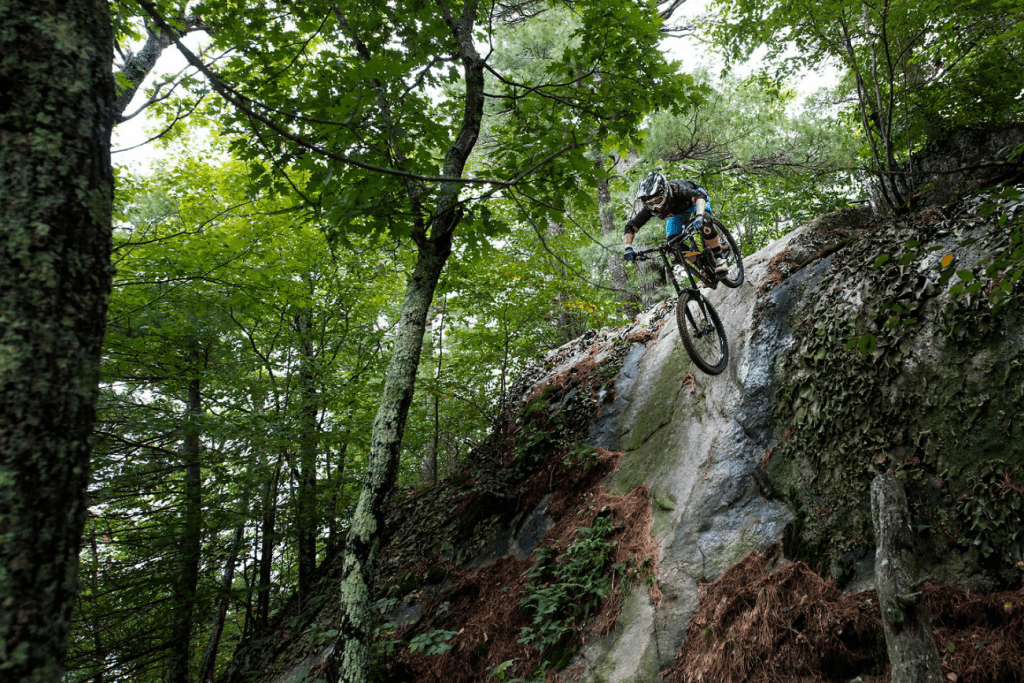
The descent requires well-developed skills to negotiate technical passages, flowing zones conducive to speed and jumps that criss-cross the slopes.

Equipment used

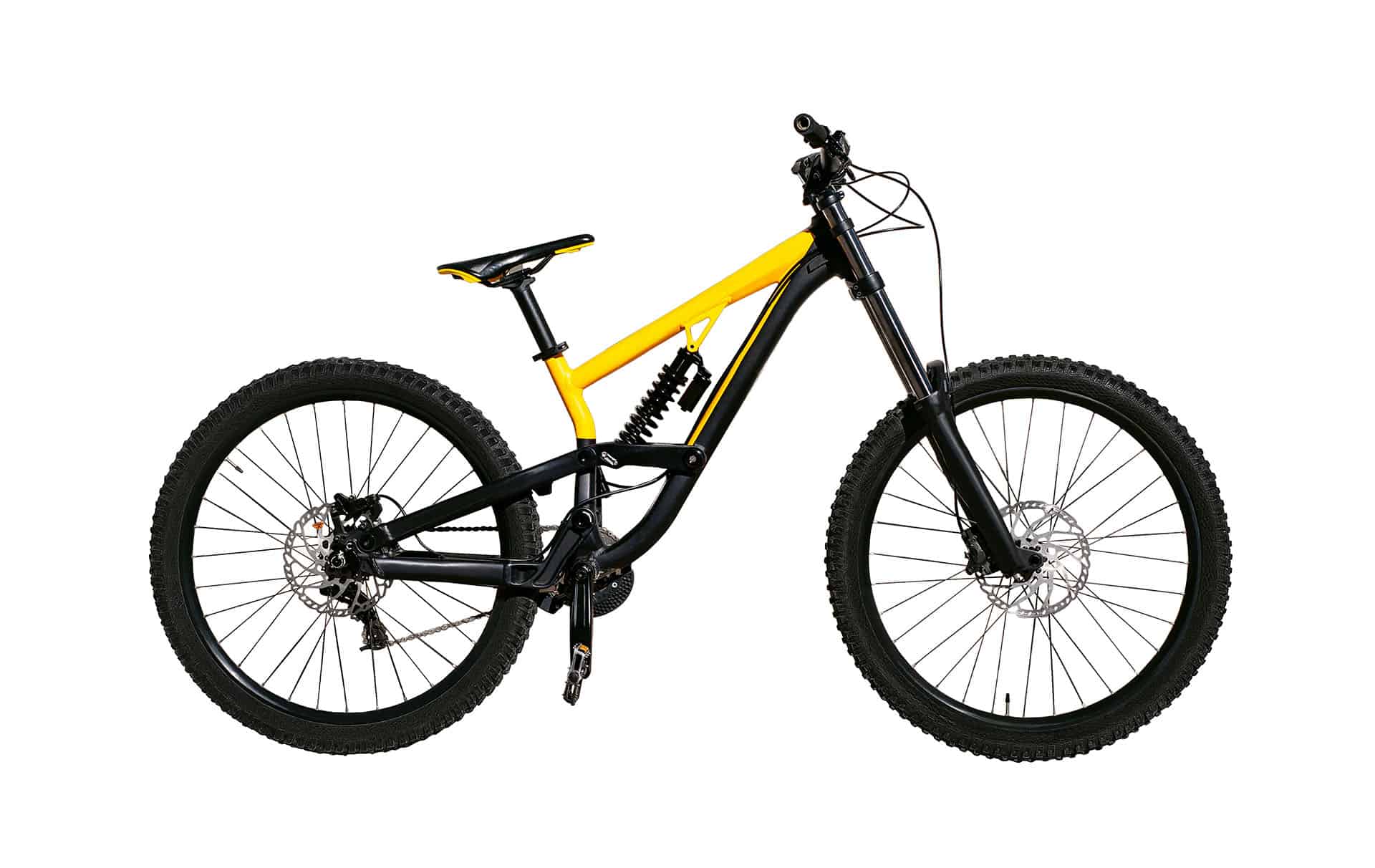
Downhill bikes are robust and heavy. They feature long-travel suspensions (usually around 180 to 200 mm front and rear) and wide tires with more aggressive lugs than in cross-country, to absorb obstacles and maintain the bike's stability. The same bikes are generally used for freeride. Frame angles are usually designed to facilitate descent, especially over obstacles or steep sections.

Downhill cyclists generally wear full protective gear, including full-face helmets and body protectors.

The trails

Downhill riding is practiced on narrow trails, punctuated by sometimes steep slopes and obstacles requiring a certain technique to overcome. The surface of these trails can be irregular in places, although the trend is towards manicured trails punctuated by natural or man-made obstacles.

Trail difficulty is expressed in the same way as in cross-country and enduro, by means of pictograms.

Photos: Shutterstock, Sentiers du Moulin, Shutterstock

×