











Bike + public transit
Cycling and public transport have similar qualities and complementary characteristics. They are both environmentally friendly and require little public space.
Cycling is the most efficient means of transport within a radius of less than five kilometers, while public transport is the fastest for longer distances. Their exclusive corridors (metro, train, reserved lanes) help avoid traffic congestion. The fact that you don't have to park your vehicle at your destination saves you time and money, as well as space and money for the municipalities and private organizations that would otherwise have to provide parking.
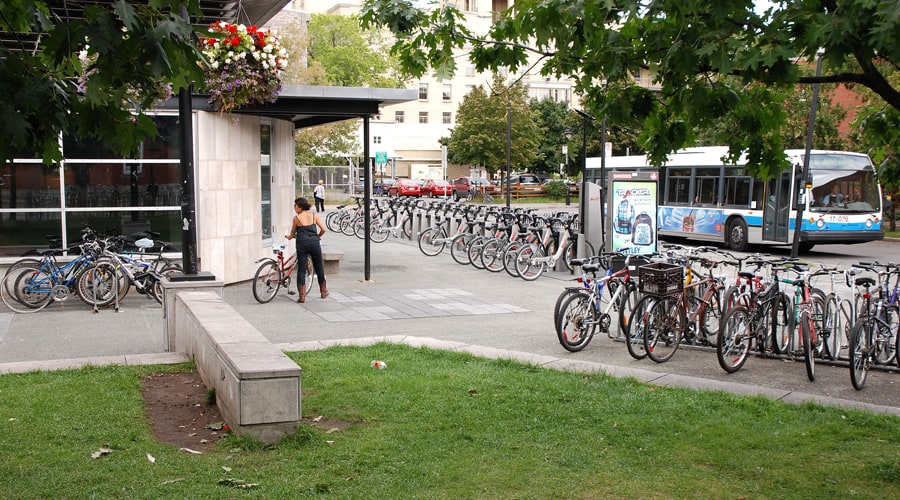
The bicycle can be used as a collector for major public transport routes (metro, train and express bus). For a trip of equivalent duration, it is much more efficient than walking. It has none of the scheduling constraints of buses, and can serve sparsely populated neighborhoods where a bus route is not cost-effective. It is less expensive than the car, both for the user and for the road network manager. And it requires 10 times less investment than cars for park-and-ride facilities at stations and terminals.
Bicycle accessibility on public transit vehicles enables cyclists to cross long distances, obstacles such as waterways, and sections of the road network that are off-limits to cyclists, such as highways, bridges and tunnels. It also provides access to the outskirts of major urban centers and their recreational cycling networks.