








When I was asked in April to write about my relationship with cycling, I didn't hesitate for a second. What an honor it would be to write a 1,000-word essay on the subject of bicycles, while waiting to get on my two-wheeled steed.
I'm glad that Vélo Québec is giving a voice (a path?) to all kinds of enthusiasts, because there's diversity among cyclists too.
I'm not a cycling shorts rider, nor am I a cycling crusader. But I am more than just a Sunday cyclist. A lover of bike paths.
I can't tell you how many kilometers I ride a year, because the odometer isn't exactly in my blood. I'm more in the Daniel Bélanger clan. I sing with him:
« ... I ride my bike
Head in the stars and in the void
The wind is soft, I'm hallucinating
I ride my bike
The night is clear
The deserted path
I am invincible
Untouchable and immortal »
My love affair with two wheels began in what I consider to be Quebec's cycling paradise: the Outaouais region.
I challenge you: type in the words paradise, cyclists, Gatineau, and you'll see a host of articles on the incredible range of bike paths in this region. We're talking about a network of over 600 km!
I witnessed the beginning of this revolution. When I was 10-12 years old, how many times I escaped into Gatineau Park with my friends Jacques, Gilles and Henri on the dirt track leading to Pink Lake. On my bicycle-blue-no-speed, I was doing something like mountain biking before its time.
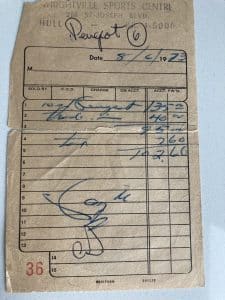
When the tracks were paved, I used all my savings to buy the ultimate bike of the time, a Peugeot 10-speed. I still have the bill. In June 1973, 50 years ago, the selling price of this dream bike was 135 $!
A crazy expense that I wasn't the only one to make that year. According to Vélo Québec, there was a bike-boom in North America in 1973-1974. For the first time, more bicycles were sold than cars! At the time, we were in the midst of an oil crisis.
In fact, it's fair to say that the history of cycling in Quebec began at this point. In 1973, the Fédération québécoise de cyclotourisme (later Vélo Québec) published its first newsletters on the subject. There were 8 issues of Cyclo-news.
It was also in 1973 that I met my girlfriend. Would we still be together if she hadn't enjoyed cycling? Maybe not. While I rode on the thin tires of my French Peugeot, she pedaled happily on her sturdy Raleigh bicycle, a great British brand. What a great tandem we made on the trails of the bicultural National Capital Commission (NCC)!
In 1977, my enthusiasm for cycling was put on hold when I moved to Quebec City for my studies. I left my Peugeot with my brother, because in Quebec City, a city of hills, cycling wasn't very popular. The route between the Saint-Jean-Baptiste district, where I live, and Laval University is not very welcoming to cyclists. It wasn't until Mayor Bruno Marchand (in 2023!) that the promise of a bike lane along Chemin Sainte-Foy finally came true. The path, complete with bollards, should see the light of day this autumn!
Let's continue our journey through time with a detour to Toronto. My relationship with cycling in Canada's metropolis, from 1981 to 1989, was no better than in Quebec City. When I arrived, the major achievement was to have changed the manholes to prevent cyclists from getting their wheels caught in them, and the cycling network was rather sparse. Two trails are making the headlines. The Poplar Plains Lane is demonized by motorists who feel it encroaches on their territory, while cyclists find it poorly designed. The other, on Wellesley Street leading downtown, isn't exactly a hit. Nothing to encourage me to buy a bike.
But, let's be honest, during my years in Toronto, a very charismatic municipal politician made cycling his hobbyhorse. Jack Layton, Bicycle Jack as he's known, forces the issue at City Hall. «I saw the future,» he tells his fellow aldermen, "and it was on a bike!"
He was responsible for the first standing committee on cycling at Toronto City Hall, which paved the way for an era of bicycle link development, including the Martin Goodman Waterfront Trail, a 56 km-long runway that will soon be 40 years old.
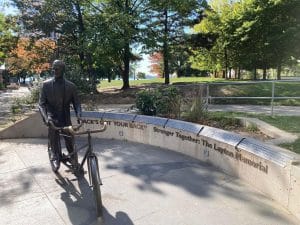
It's no coincidence that a statue of Jack Layton has been erected in Toronto. Fittingly, the man is depicted on a bicycle... better still, on a tandem. The public is invited to take a photo with him in the captain's seat.
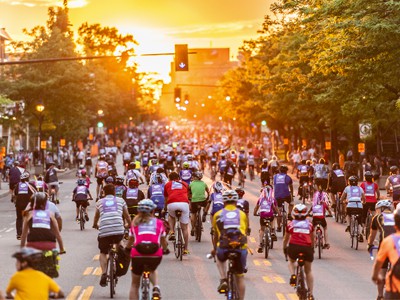
When I arrived in Montreal, I discovered a city with a passion for cycling. In 1990, 38,000 people registered for the Tour de l’Île de Montréal, an event that had attracted 3,500 people 5 years earlier.
On June 3, 1990, the Tour was a tough expedition. The route is 67 km long! I'm content to be a spectator, since I haven't had a bike for years.
In 1991, how could anyone resist the call of Louise Latraverse, honorary president of the Tour de l'Île. In the event's program, her words go as follows: «I spent my childhood on a bicycle and put it away when I moved to Montreal. Thanks to Foglia, Michel Labrecque, Vélo Québec and all cycling enthusiasts, I've got my bike back!»
Well, well, well! I did the same, and so did my girlfriend. It was a big expense, because in addition to the new bikes, we had to equip our very first car for life with a bike rack. Since Montreal's network of bike paths isn't very well-developed yet, we figured we'd better have something to attach our bikes to the car so we could go out. Like returning to cyclists' paradise, in a Outaouais.
Cycling isn't expensive once you're properly equipped. But as you know, when the family grows, we often have to put our hands in the wallet to include the little ones in our new hobby.
From the moment Fiston entered the picture in 1993, we had to buy a child's seat, a trailer, a small four-wheeled bike, a junior bike, a road bike, and helmets for our growing heads.
What can't we do to instill a love of cycling in our children? In my case, I even took my son to the Radio-Canada parking lot on weekends so he could learn to ride safely on two wheels. Now that he's grown up, I'm giving him an annual subscription to BIXI for his birthday, to diversify his active transport offer.
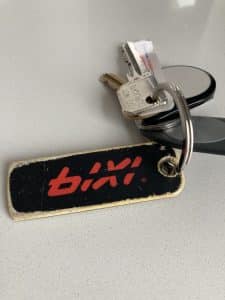
Because I have to add this to my relationship with cycling: I'm a die-hard BIXI fan. A subscriber since the very beginning (May 2009), I even pride myself on having an original key!
I'd like to take this opportunity to salute the late André Lavallée (1952-2022), the man who brought BIXI to Montreal. This bike-sharing service is one of Montreal's finest creations of the new millennium. It's as if this mode of transport, so popular before the Great Wars, had once again become a must-have in the city.
I remember how original we ‘bixistes’ looked at first, riding around on our tank. Today, the service is widely used, and it's a joy for me to see the hordes of tourists visiting our city on this sturdy bicycle from the imagination of designer Michel Dallaire.
My personal bicycle is for hiking. When it comes to getting around town, I love the freedom that comes with hooking up a BIXI as I go and leaving it at my destination without ever having to worry about having a lock.
I can't tell you how sad I feel when November 15 rolls around and the BIXI season comes to an end!
But look at how well life works: I started writing this text while waiting for the 2023 BIXI season to open, and I didn't even have time to finalize it before they were already in place at the 865 stations scattered across the country. What's more, I won't have to mourn the end of the season in November, since they'll finally be rolling year-round. One more star in the book of Montréal-ville-nordique!
In the meantime, don't look for me, I'm on a bike path, often on the Berges bike path along the St. Lawrence River, the most beautiful, my favorite, storing up more memories of summer on two wheels.
Claude Deschênes, cultural journalist