

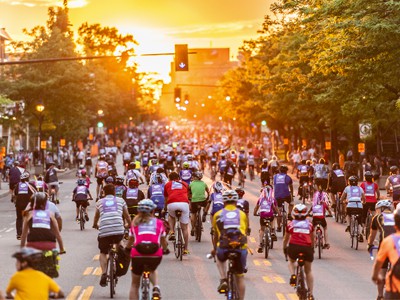



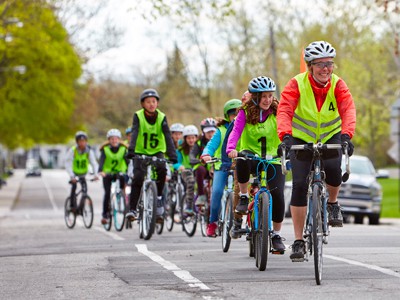



Every year for the past 40 years, the car has given way to the bicycle for a few hours on the occasion of Tour de l’Île de Montréal. It may seem like an obvious gesture, but it's a minor miracle.
To appreciate this, we need look no further than the social and economic context of the early 1980s. With the second oil crisis propelling petrol prices to record heights, the idea of getting around on a bike suddenly made a lot of sense. The only problem was that the object itself, symbolically associated with children and environmentalists, was anything but popular. How can we impose it in the public space, to normalize its place there?
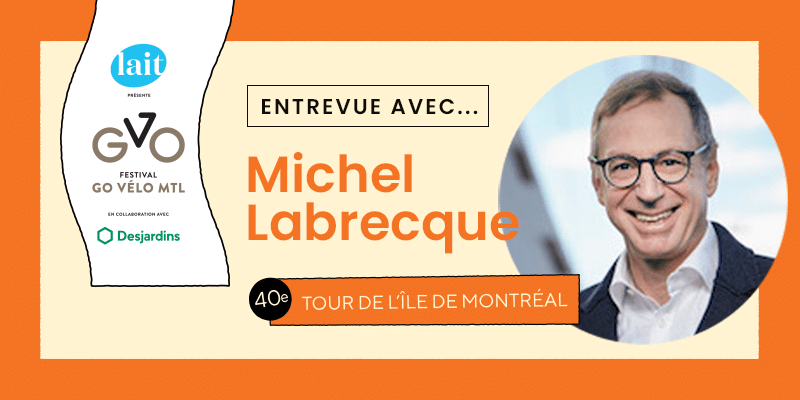
At Vélo Québec, which has just adopted this name, we believe we have the beginnings of an answer to this question. We were calling for cycling facilities to encourage free and safe cycling,« recalls Michel Labrecque, who was working at Vélo Québec at the time, before later becoming President and General Manager. One of the ways we wanted to achieve this was to create a popular event which, by getting non-cyclists pedaling, would rally them to the cause.»
The ingredients for success
In 1983, a small delegation headed for the Big Apple to take part in the Five Boro Bike Tour. Now in its sixth year, this annual bike tour, which focuses on New York's five boroughs (Manhattan, Brooklyn, Queens, the Bronx and Staten Island), was a great success. Total registrations: over 12,000! The emissaries returned delighted with their mission. So that's how you organize a mega bike event.
By this time, Vélo Québec had already begun to make its mark in the field. «We had already organized Les Grands Re-Lait, a series of five one-day urban cycling events with Les Producteurs de lait du Québec (PLQ),» recalls Michel Labrecque. The enthusiasm of Les Grands Re-Lait participants confirms that there's an appetite in Quebec for this kind of experience. «This partnership with the PLQ was going to be decisive for the Tour de l'Île,» he notes.
From the outset, Vélo Québec has made it a point of honour to remain accessible. There's no question, for example, of getting too militant, velorution-style. Nor are there any medals to celebrate the best sporting performances. «At the height of the running boom, with the Montreal Marathon enjoying a good run, we were criticized for the lack of stopwatches,» recalls Michel Labrecque.
The right moment
Nevertheless, the planets were well aligned when the Minister of Transport knocked on Vélo Québec's door in the late summer of 1985. Guy Tardif asked the little
team to organize an event to inaugurate bicycle paths in the east of the metropolis. Deadline for delivery: barely six weeks. «Luckily, we had the concept of a major event in the works, a tour of the island of Montreal,» says Michel Labrecque.
The rest is history. The first Tour de l’Île de Montréal takes place in mid-October. Some 3,500 cyclists took to the streets of Montreal for the very first time, starting out from the Olympic Stadium and paving the way for an enduring tradition. «If cycling is an integral part of what Montreal is today, of its identity, it's thanks in part to the Tour de l'Île,» says Michel Labrecque, who will be on the starting line for the event on June 1. What about you?