
















Visit bicycle economy, or the economic activities and spin-offs of cycling, is a subject that is gaining in popularity in various countries and major cities. Since 2021, France has been taking stock of the players, strengths and weaknesses of the country's bicycle industry. The French government understands that the development of the bicycle and its economic sector represents a promising element for its economy, as well as a response to the challenges of ecological transition and public health [1].
Cycling in Quebec reaches new heights
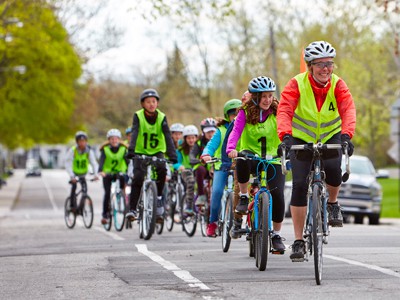
In recent years, cycling has become more popular than ever in Quebec, both for commuting and for leisure, on roads and trails. In fact, cycling is the 3rd most popular physical activity in the province, the weekly leisure activity of 1.6 million Quebecers and the occasional means of transport for 2.1 million. This popularity has generated $565 million in spending on bicycles and equipment in 2020 [2], and growth in the sector appears limitless with the explosion of electric-assist bicycles. The province's assets are numerous: half a dozen internationally recognized bicycle manufacturers, the largest bicycle route in North America (the 5,300 km Route verte), a 5,500 km urban cycling network, more than 20 cities with bike-sharing systems, and a fleet of 10 % bicycles larger than that of cars.
40 billion in France
In September 2022, France renewed its National Bicycle Plan (2023-2028). This political project is based in particular on the desire to “re-industrialize France for cycling”, and to ensure that the territory benefits from the economic value of this sector. After a first plan of 450 million euros launched in 2018 for 5 years, for 2023 alone, the government plans investments of 250 million euros. This strong political choice is based on conclusive data showing the colossal economic benefits of cycling, whether for industry, retail, tourism or urban logistics.
A study carried out in 2020 [3] measured that the economy heart The bicycle industry in France - manufacturing, sales, repair, design and construction of bicycle facilities - is worth 2.5 billion euros ($3.4 billion) annually, and represents 13,500 jobs. If we add bike tourism and bike logistics (delivery), the economic spin-offs reach a total of 8.2 billion euros ($11 billion), while consolidating 78,000 jobs. Finally, if we take into account all the positive externalities associated with cycling, particularly in terms of health, the cycling sector contributes 30 billion euros ($40 billion) to national wealth every year. To put this figure into perspective, it's equivalent to twice the annual budget of Quebec's Ministry of Education, which is the second-largest contributor to the province's economy [4].
What about Quebec?
With the growing popularity of cycling in Quebec, and the role it can play in terms of the environment, health and the economy, it would be more than appropriate to conduct a study to assess its weight in the national economy, and what it collectively brings to Quebecers every year. Studies in other countries such as France and Germany, and in major cities such as New York, Toronto, Copenhagen, Portland and London, have shown that cycling generates huge direct and indirect economic spin-offs, for relatively minimal investment when compared with other sectors.
At a time when economic forecasts are uncertain, and political orientations and infrastructure projects don't always seem aligned with the climate imperatives of the moment, investments in active transportation - including cycling - appear more than ever to be a simple - and economically winning - solution to complex problems. To this end, the Quebec government would do well to launch a research project on the veloconomy, so as to have a precise, up-to-date picture of its impact on the national economy.
[1] Guillaume Gouffier-Cha, Filière économique du vélo. Rapport. Mission sur la filière écononique du vélo en France, January 2022: https://igedd.documentation.developpement-durable.gouv.fr/documents/Affaires-0012572/014115-01_rapport-publie.pdf;jsessionid=C9775605A7A5E81C5F4F0AA195C5E815
[2] État du vélo au Québec 2020: https://www.velo.qc.ca/wp-content/uploads/2021/06/vq-edv2020-fr.pdf
[3] Impact économique et potentiel de développement des usages du vélo en France en 2020 ; https://librairie.ademe.fr/mobilite-et-transport/332-impact-economique-et-potentiel-de-developpement-des-usages-du-velo-en-france-en-2020.html
[4] https://www.budget.finances.gouv.qc.ca/budget/2022-2023/documents/Budget2223_PlanBudgetaire.pdf#page=38