












In June 2001, Vélo Québec met with Montreal's transition committee, responsible for the amalgamation of municipalities on the island of Montreal, to ensure that cycling was not forgotten in discussions on the distribution of powers between the central city and the boroughs. The following document was submitted to the committee.
The importance of the phenomenon
The notorious presence of cyclists on the streets is one of the defining phenomena of today's Montreal. The following is a brief overview of the phenomenon.
It is estimated that over 1.1 million bicycles are owned by households on the island of Montreal. The number of users of these bicycles is 710,000. These 710,000 cyclists can be broken down as follows:
- 560,000 are adults, and they represent 42 % of the 18 to 74 year-olds living on the island of Montreal;
- 150,000 are under the age of 18, representing 65 % of all children living on the island.
Between the post-war years and the 1960s, the bicycle was mainly a children's toy. It was in the 1970s that the number of adult cyclists became dominant. This ageing of the cycling population was accompanied by the discovery of the bicycle as an urban vehicle.
Nearly 145,000 residents of the Island of Montreal, or 26 % of all adult cyclists, say they use their bicycle as a means of transportation. In certain central Montreal neighborhoods, the bicycle is used for 11 % of all trips during the summer.
The cycling season usually runs from mid-March to mid-December, with a peak between May and September. Nevertheless, over 50,000 adults residing on the island of Montreal report cycling between December and March.
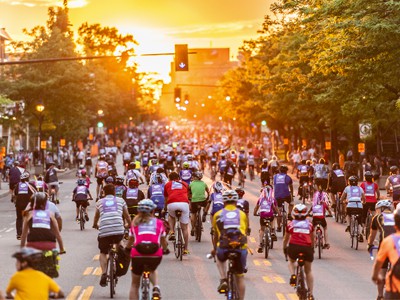
Montreal is host to a number of renowned cycling events. Chief among these are the Tour de l'Île and the Tour des Enfants, which since 1999 have been marketed as the Montreal Bike Fest. The Montreal Bike Fest, which takes place between the last Sunday in May and the first Sunday in June, is part of the Regroupement des grands événements majeurs internationaux du Québec.
The island is also the scene of major international competitions, which have the singularity of usually taking place on Mount Royal. These include the Women's World Cup, in which runner Geneviève Jeanson distinguished herself in June. In the past, we've also seen the Olympic Games, the World Championships (in 1974), the Grand Prix des Amériques and the Classique cycliste de Montréal.
Montreal's reputation as a cycling city has been growing over the past decade. In 1992, Montreal hosted a resounding world conference on the integration of cycling into transportation policies. In 1999, the prestigious American magazine Bicycling crowned Montreal America's top cycling city. Major newspapers such as the Boston Globe and the New York Times have published major articles extolling the charms of Montreal on two wheels. Tourisme Montréal now adds cycling to the list of assets that make Montreal an incomparable urban destination.
The Metropolitan Bicycle Network
With the support of the Ministère des Affaires municipales et de la Métropole, Vélo Québec is coordinating cycling initiatives throughout the metropolitan area. This initiative, known as the Réseau vélo métropolitain, aims to unify the metropolis's discontinuous network of bicycle paths. It also aims to integrate cycling into the public transit system.
Since 1998, the Quebec government has invested some ten million dollars in bicycle lanes. It has also led to studies, technical symposia and pilot projects.
At present, the Réseau vélo métropolitain is taking shape as follows: a dozen or so routes, including metropolitan connections, links with airports and the Quebec-wide Route verte project, and links with municipal bikeways. One-third of the planned 600 kilometers have already been completed. The Réseau vélo métropolitain provides a link between the local level of bicycle development and the regional level.
Eventually, this metropolitan network will be uniformly signposted. It will make it possible to cycle all the way around the metropolitan area, crossing it on different routes from north to south or east to west.
An observation
The territory of the island of Montreal is lined with some 345 kilometers of bicycle paths, nearly half of which are located in the actual city of Montreal. In the 28 municipalities on the island of Montreal, the importance of cycling varies greatly, and this is reflected in the inter-municipal concerted efforts to develop major routes. An eloquent example of this is the Tour de l'Île, begun in the mid-1980s, which has yet to be completed.
In other words, the development of the cycling network on the island of Montreal has been paralyzed for over 15 years by the multitude of decision-making centers. In addition, this state of affairs has given rise to varying development standards and maintenance practices from one municipality to another. What's more, different departments are mandated to look after the trails. In some cases, public works is the prime contractor for bicycle lanes. Elsewhere, this responsibility falls to parks or recreation. In the early years, the City of Montreal innovated by integrating it into the Traffic Department (which later became the Traffic and Transportation Division).
Cycling could be one of the beneficiaries of the merger of all the island's municipalities. With a single administration responsible for the territory, it will be possible to build a unified network of bike paths, and to imagine being able to cross the island along several axes. The unification of the municipal administration will make it possible, insofar as a level playing field prevails, to standardize bikeway development and maintenance practices. Moreover, for these benefits to be manifest, bicycles will have to be integrated into transport and traffic planning in the same way as other modes of transport.
The role of the central city
Our understanding of Bill 170 is that the central city holds the power to make bike lanes on the streets. If the boroughs were given responsibility for cycling, the current situation, in which the cycling network lags behind the needs of cyclists, would be perpetuated. If the development of an island-wide cycling network is to be coherent and coordinated, the planning of such a network must be centralized.
Centralized planning would make it possible to identify an island-wide Montreal network. The attached preliminary diagram of the Réseau vélo métropolitain outlines the main lines.
Which service?
The first generation of trails used residual spaces to make their way. These trails skirted the riverbanks, helping to reclaim access to the shores around the island.
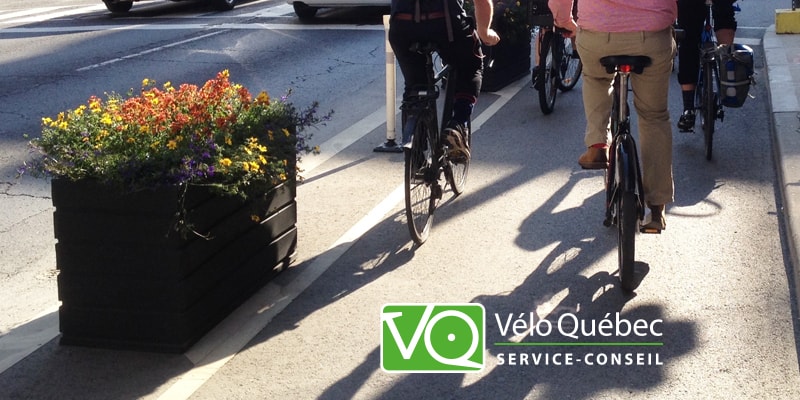
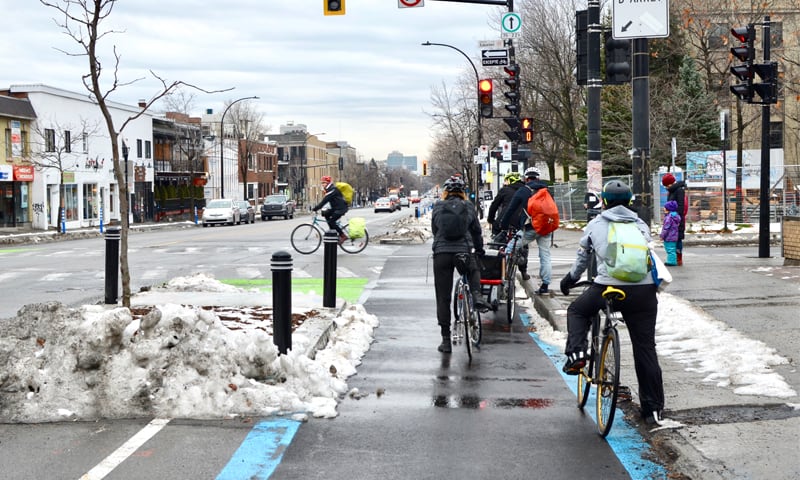
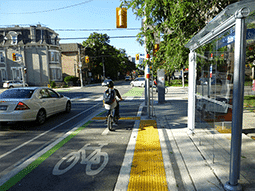
It's very difficult, if not impossible, to achieve a continuous network across the entire island by staying in the parks. That's why a second generation of bike lanes has begun to appear in many places, including the present-day city of Montreal. These bike lanes are essentially on-street, in the heart of urbanized neighborhoods.
The reason is simple: it's the only space available. What's more, bicycle users want to be able to go everywhere by bike: to work or school, to do their shopping and have fun.
As a result, planning a bicycle network is no longer any different from planning a road network. It's all about managing movement and organizing the sharing of the street between different users. Since streets are the domain of public works, the traffic department (public works, engineering) must be in charge. This is where the expertise lies to manage traffic flows and implement a safe cycling network.
In what is now the City of Montreal, the issue was transferred from the Parks and Green Spaces Department to the Public Works and Environment Department in the early 1990s. This is what European and North American cities with significant cycling populations do. We should maintain this approach.
A bicycle office
Given the size of the next City of Montreal, a bicycle office should be set up within the Traffic Department. This office would bring together a small multidisciplinary team. It would be dedicated to the planning and development of bicycle lanes, as well as to bicycle safety education. This office would liaise with the Police Department, as well as with the Parks Department when existing trails cross Montreal parks.
Major cycling events
Montreal is also the scene of cycling events such as the Féria du vélo de Montréal, which has an international reputation. Municipal oversight of a major event like this, which takes in dozens of kilometers of streets and calls on a host of municipal and other services (fire, police, special events, hospitals, Urgence-Santé, etc.), needs to be at the level of the central city. In today's Montreal, this responsibility falls to the Service des loisirs, and it could stay that way. The Service des loisirs could also be given responsibility for promoting cycling as a recreational, sports and leisure activity.