








Cities such as Copenhagen, Amsterdam, New York and Vancouver all have different approaches to bicycle infrastructure. Differences in widths, traffic signs, colors, materials and traffic lights modify needs and approaches to cycling infrastructure. Citizens, too, behave differently from one city to another. They will use the space and appropriate the facilities in their own way. It is therefore appropriate to speak of cultural differences in cycling facilities.
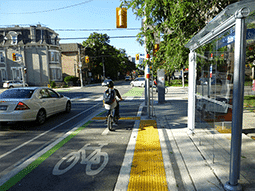
In my opinion, the copy-and-paste approach from one country to another is therefore unsuitable. For example, separating pedestrians and cyclists on a sidewalk with a shade of color and discreet pictograms works very well in Gothenburg, Sweden, but is a failure on De Maisonneuve Boulevard, near the Maison symphonique, in Montreal. Don't get me wrong, best practices do exist, but there are nuances in their execution depending on the culture.
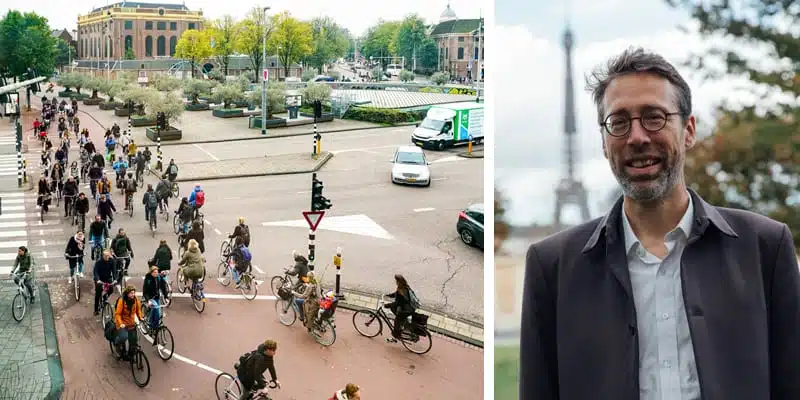
It was Suzanne Lareau who first told me about Stein van Oosteren, when she was writing the preface to her book Why not ride a bike? to be published by Éditions Écosociété. Stein is a Dutchman who has lived in Paris for several decades. «Curious», I thought, «how come I've never heard of him? When the book came out, I discovered a pragmatic author with an enlightened vision of the various aspects of cycling. His humorous book offers a privileged access to the whole world of cycling: planning, economics, barriers, safety, but also pleasure and freedom.
I was lucky enough to meet Stein in September 2021. I was struck by her energy and passion. Her boundless generosity and curiosity, combined with her great empathy, made each meeting unique. For over three hours, we talked endlessly about his work and the reasons that led him to write a book to document his experiences. Through her volunteer work with the Collectif Vélo Île-de-France, He discovered the power of collective intelligence and group work.
His binational outlook enables him to approach issues with depth and perspective, to name the various barriers to practice, and to present concrete solutions. This is what he has done in France, and what can serve as an example for Quebec. Arriving in Paris with a typically Dutch vision of the place of the bicycle in society, he quickly fought to integrate it into the French capital and its suburbs. Starting from a modest goal, he seemed almost surprised to be taken seriously and listened to by the region's government authorities.
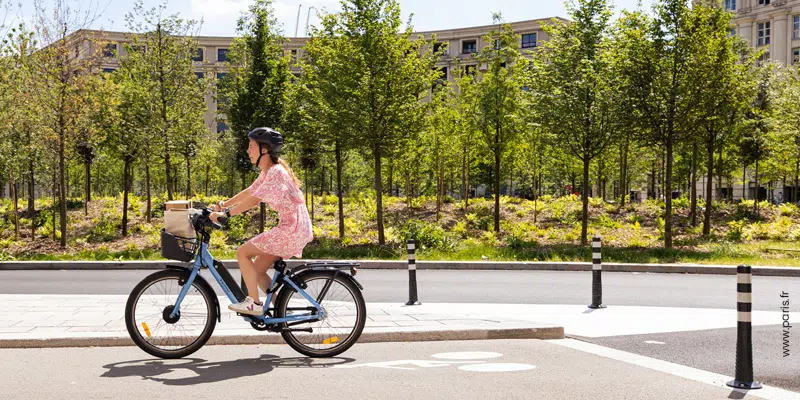
In just a few years, thanks to the work of people like Stein and Mayor Anne Hidalgo, Paris has undergone a complete metamorphosis. Car traffic is still pretty brutal in the Paris arrondissements, but bike lanes have sprung up all over the city. Visit rue de Rivoli has become a symbol of Parisian cycling success. The drop in traffic caused by the pandemic certainly didn't hinder the rapid completion of these projects, but the fact remains that it's only by thinking big, with ambitious projects, that we can change the travel habits of a city's - and a country's - inhabitants.
That's why, as was the case in Paris, we can't be afraid of big changes. We need to rethink our urban spaces, reimagining them with active transportation at their core. It's thanks to this desire that Amsterdam has gone from a city full of cars to the cycling paradise we know today. That's how Paris made an impressive turnaround in terms of cycling infrastructure in just a few years. This is how Montreal, and the rest of Quebec, must think about the ongoing integration of cycling into its roadways.
A UNESCO diplomat for the Netherlands, Stein Van Oosteren has a talent for popularization and communication. This energetic and passionate man leaves no one indifferent. On June 2, Vélo Québec will welcome him as part of the Festival Go Vélo Montréal for an exclusive conference. This free event, offered in person or virtually, will be a great opportunity to hear in French about the Dutch approach to cycling. His experience in Paris also gives him a good grasp of the cultural differences when it comes to planning. It's a conference not to be missed.
Jean-François Rheault
president and chief executive officer