










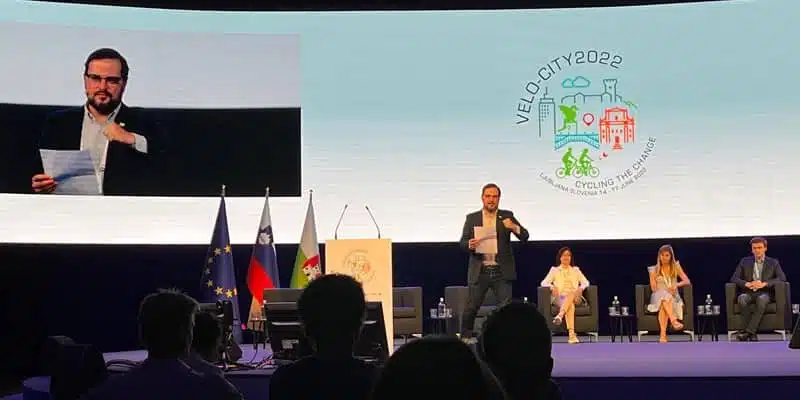
After a cancellation in 2020 and a hybrid version in 2021, the Velo-City conference returned to its usual format last June in Ljubljana, the capital of Slovenia. Building on the great acceleration of cycling during the pandemic, progress was visible in the various presentations given by speakers from all over the world. In addition to the usual leaders such as Amsterdam and Copenhagen, several cities offered inspiring presentations on the role of cycling as a mobility tool and a vector for social change.
An exceptional host city
It has to be said: the Slovenian city of Ljubljana is a jewel. With a population of 280,000, the country's capital made a bold choice in 2007 by pedestrianizing the city center. At the time, only 40 % of residents were in favor of the project. Through various evolutions and adaptations, it is now more than 17 hectares accessible to pedestrians and cyclists. Today, more than 97 % of the population supports these major changes that have made the city much more pleasant on a human scale. Of course, now that everything is in place, no one would dream of going back.
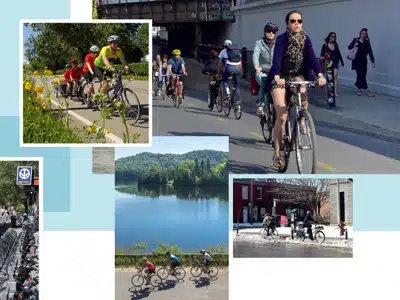
This success is mainly due to political will and the sharing of experience with other cities around the world, which has enabled us to design a city center adapted to the needs and lifestyles of its residents. As for the cohabitation of pedestrians and cyclists, it's a happy one. By adopting a similar approach At Avenue du Mont-Royal in Montreal, space sharing is designed to encourage good behavior and empower users, rather than limiting access by segmenting spaces according to mode of transport.
Will France soon be the world's top destination for bicycle tourism?
Among the highlights of the conference, the acceleration of bicycle infrastructure in France was certainly impressive. On the one hand, the Fédération française des usagers de la bicyclette has rolled out several programs in recent years. Whether it's teaching cycling in schools, training in active mobility, bike parking or even subsidizing the purchase and maintenance of bicycles, investment in cycling in France is booming. Since 2020, a total budget of over 300 million euros has been set aside to support cycling.
As far as local authorities are concerned Bicycles and regions is worthy of mention. The development of data through its various observatories provides a clear understanding of the acceleration of cycling in the country. So much so, in fact, that France has set itself the goal of becoming the world's leading destination for bicycle tourism. On this subject, the director of the association is clear We need to measure our success in tourism in a different way, and stop measuring it solely in terms of tourists arriving by plane. We need to demonstrate the importance of domestic tourism«. Here are a few ideas for the Action plan for sustainable and responsible tourism from the Quebec government.
Resistance to change, a global issue
Throughout the various presentations and speeches by elected representatives, the theme of opposition came up repeatedly. The removal of space for cars stirs passions. From one city to the next, the stories are similar: no matter the size of the plan, the attacks and threats are fierce. Fortunately, elected officials who stay the course always succeed in advancing the common good in their city.
In this context, where resistance is equal no matter what the plan, ambition is the best avenue. Sigrid Z. Heiberg, an elected member of Oslo's city council, made the following statement colorful quote There will be opposition, but cities have to evolve, even if old men don't usually change their opinions! Elected official responsible for mobility in Ghent, Belgium was categorical We need to include cycling in all our projects to get things moving.
Leaving Ljubljana, the assessment was clear: cycling is on the move everywhere. It's not just a movement, a cause, isolated examples; cycling is emerging as one of the most obvious solutions to a host of crucial societal issues, from climate change to urban sprawl, to the physical and psychological health of the population. That's why cycling is progressing everywhere, and why places that choose not to join in this progress can only go backwards.
Jean-François Rheault
President and CEO, Vélo Québec