
















Montreal, February 6, 2018 - Today is the day that Vélo Québec presents its position on Bill 165 amending the Highway Safety Code (HSC) to the members of the National Assembly's Committee on Transportation and the Environment.
Vélo Québec provides an exhaustive analysis of the bill, highlighting a number of good ideas, but also proposing more ambitious avenues to the legislator, with very concrete suggestions that go beyond simply catching up with the reality of our streets and roads.
From the outset, Vélo Québec presents a few facts:
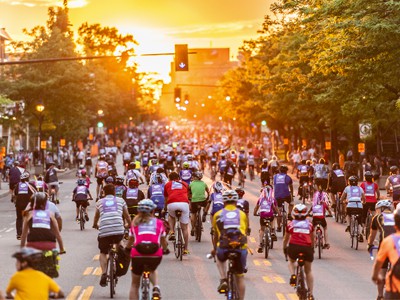
- Quebec is cycling more and more, despite its aging population, and now boasts 4.2 million cyclists, 2.7 million of whom cycle every week;
- 40 % of cyclists use bicycles as a means of transport, this proportion being 55 % in Montreal, Quebec, Sherbrooke and Longueuil;
- Cyclists' road safety record is improving, but the gains are fragile. The increase in the number and weight of motor vehicles, as well as distracted driving, are being blamed.
In its brief, Vélo Québec welcomes some of the bill's proposed additions:
- The precautionary principle, which establishes greater responsibility towards the most vulnerable
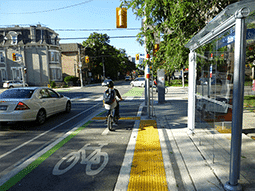
- New shared spaces such as bike lanes and shared streets
In return, Vélo Québec makes a number of suggestions to put pedestrians and cyclists back at the heart of the new Code:
Clarifying the precautionary principle
It must not create a false equivalence of responsibility, nor require vulnerable users to take more precautions. In particular, the CSR must not place the responsibility of being seen on them.
Bike lanes and shared streets
Priority for pedestrians and cyclists must be asserted even more strongly than specified in the bill, and systematically in these two types of environment. Motorists in these environments are in a sense «guests».
Penalties - depending on dangerousness
Bill 165 puts an end to a long-criticized inequity by abolishing demerit points for certain cycling offences. On the other hand, the increase in fines is substantial! Vélo Québec continues to advocate for penalties that are proportional to the danger to others, and calls for penalties to be lowered to a range of 30$ to 50$.
Staying one step ahead for greater safety
The new CSR must recognize the situations most at risk for cyclists, and not hesitate to give them a head start at intersections. To avoid blind spots, especially those caused by heavy vehicles, we reiterate that cyclists should be able to take advantage of the exclusive phases offered by pedestrian lights to leave intersections, and to make right turns at red lights, even on the island of Montreal. This would also improve traffic flow, which would be consistent with efforts to promote sustainable mobility and physical activity! We also propose that cyclists should be able to treat stops as yield signs, a practice that is common, risk-free and adapted to their reality.
Vélo Québec's analysis, presented today to the National Assembly, proposes a series of adjustments and nuances to ensure even greater consistency between the desire to better protect the most vulnerable and the concrete ways of doing so.