









You don't see many bicycles in post-apocalyptic stories.
I've been a fan of the genre ever since I saw 28 Days Later when I was a teenager. In this case, the absence of bicycles makes sense: 28 days after a worldwide pandemic that turns everyone into zombies, it's believable that we'd keep the same transport reflexes, and try to escape monster-infested London in a black cab. (Ironically, it's a bicycle accident that triggers the film: the main character, a courier, is involved in an accident that plunges him into a coma from which he wakes up after the 28 days of the title).
But in a work like The Last of Us, which takes place 20 years after a similar event, it seems to me surprisingly counterproductive that the characters are still chained to their cars, especially as gasoline has the unfortunate tendency to lose its combustibility after a few months. The Mad Max universe is even more surprising in this respect: in a world where civilization has collapsed due to oil wars, the characters cross the desert... burning gas in their cars. muscle cars.
I'm digging my heels in, of course: if I suspend my disbelief to believe in the collapse of the world as depicted in a story like The Road, I should also be able to imagine a magical world where gas never runs out and always stays fresh. But it would seem more credible, dramatically, thematically, if the characters spent more time cycling there.
Whether consciously or not, almost all of these post-apocalyptic stories put forward a very conservative vision of the world: they celebrate individuality, resourcefulness, the primacy of family ties and the immediate tribe, while exposing the fragility of a centralized state and the danger posed by the Other and the Unknown. It seems to me that there are few technological innovations as well-suited to this worldview as the bicycle. The bicycle doesn't depend on a centralized service, like the cell phone, or a supply chain, like the car. Its mechanics, despite a few changes, have resisted the over-sophistication (and planned obsolescence) seen in far too many everyday objects. Learn a few basic mechanical notions, and you're suddenly as free, autonomous, independent and powerfully virile as Brad Pitt in World War Z.
And yet, a simple review of the Quebec media suggests that bicycles enjoy the right to vote, which they exercise, en bloc, in favor of the Communist Party, and that they spend all their free time slashing tank tires. If the most vehement critics are to be believed, bicycles are the business of anti-capitalists and ecofascists.
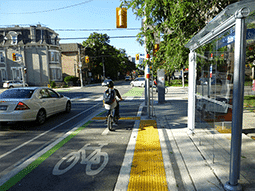
It's not that cycling can't, or shouldn't, be a political act. Quite the contrary. But its political potential seems to me tragically under-utilized, particularly by the right. Parties and organizations concerned with reducing government spending would do well to compare cost-benefit analyses of projects to widen boulevards with those to add lanes for active transport. The densification «craze» - ideal for active transportation, but derided by former Transport Minister François Bonnardel - has everything it takes to seduce an economically conservative government: it allows more efficient use of financial resources from different levels of government. What's more, we all know that a government that wants to reduce its healthcare bill - the government's most expensive item - has every interest in prevention rather than cure... and that daily physical activity is an enormous determinant of overall health.
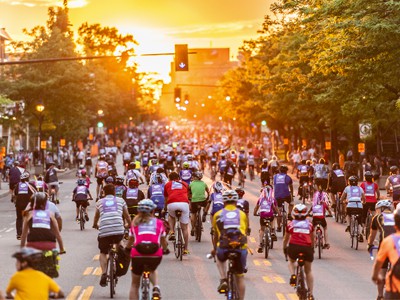
But the bike has not to be a political act. The latest five-year survey on cycling in Quebec, commissioned by Vélo Québec and published in 2021, concluded that 54% of Quebecers had ridden at least once in the previous year. That's a lot of citizens who can agree on at least one point: riding is the best way to get around. fun. If we don't want to talk politics, we'll always have this point to fall back on.
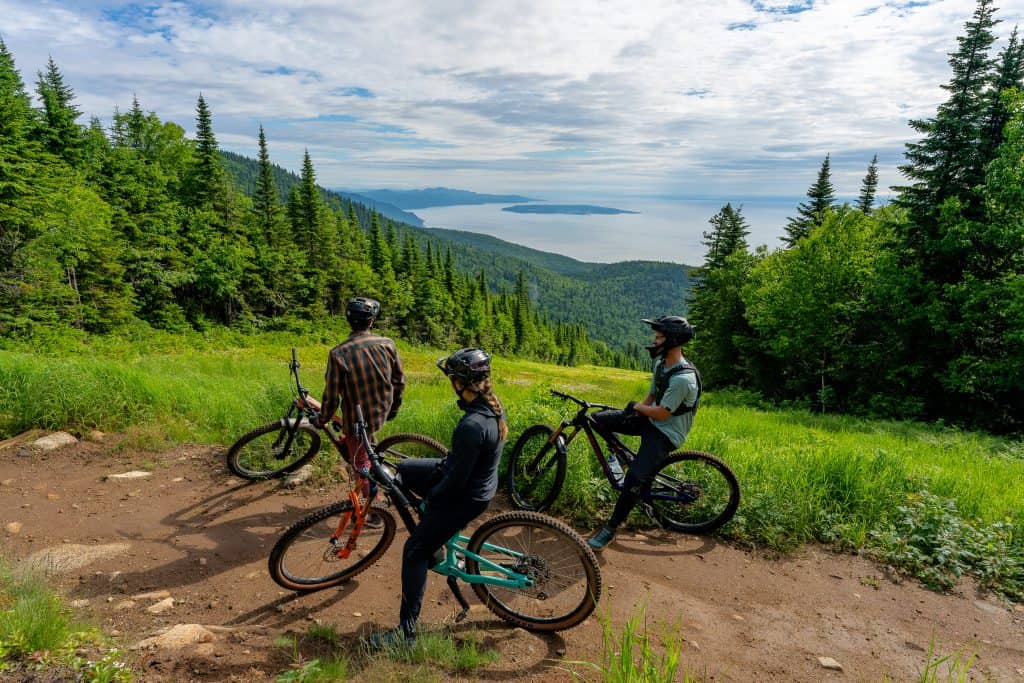
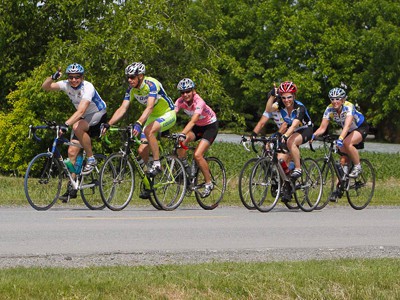
My family is a good example: we know better than to talk politics, because we often have divergent positions. As divergent as our cycling practices, in fact: our parents all bequeathed to us, my four sisters and I, their love of two-wheelers, which we have each embraced in different ways, from utility bikes to mountain bikes to triathlons. We get together on two wheels, whether that wheel is clad in studded, spiked or smooth tires. We agree that it makes us happy, and that it's in everyone's interest to spend as much time in the saddle as possible.
It's in our collective interest to see the bicycle as a space where we can find common ground. It could save us from slipping into the first post-apocalyptic scenario where we see characters using bicycles to ensure their survival.