









On October 5, the people of Quebec will elect their government for the next four years. As in every election campaign, all parties are seeking concrete solutions to the very real problems facing Quebecers: the cost of living, pressure on the healthcare system, the vitality of the regions, and the future of our children. How does cycling fit into all of this?
My answer can be summed up in one sentence: a solution—regardless of the political affiliation of the next government.
Because, at the end of the day, that’s what it’s all about. Cycling isn’t an ideology. It’s a tool. And like any good tool, it serves very different purposes depending on who’s using it. Here are four key areas, drawn from our 2026 election priorities, that show how people can come to cycling through completely different paths—and find, each time, good reasons to stick with it.
For Those Who Care About Every Public Dollar
People like to say that biking is good for the planet. That’s true. But it’s also, quite simply, good for the government’s budget.
One kilometer of bike path costs a fraction of what it costs to maintain one kilometer of road. Yet the Land Transportation Network Fund is sinking into a deficit that is expected to reach $3.7 billion this year alone—one-third of Quebec’s overall budget deficit—while its revenues, which come primarily from the gas tax, are eroding as the vehicle fleet becomes more electric. Our transportation system, which is still built almost entirely around the car, is not sustainable.
There is also a more subtle, but equally revealing, inequity: an allowance paid for the business use of a personal car is not taxable, whereas the same compensation for travel by bicycle is. Whether one is concerned with fiscal discipline or tax fairness, this asymmetry does not hold water.
For those concerned about public health
Quebecers logged a total of 305 million hours of cycling in 2025. According to the World Health Organization’s HEAT tool, this level of activity alone prevents 350 deaths per year and generates more than $3.3 billion in savings—nearly 5 % of the Quebec government’s health care spending, which is nevertheless increasing by 6.8 % per year. I challenge anyone to name a health prevention tool that offers such a return on investment.
This urgency to act has, in fact, been aptly described recently. A coalition that includes Pierre Lavoie, co-founder of the Grand défi Pierre Lavoie, has compared The Quebec Model for Sports and Physical Activity in a 1967 Chevrolet : a 50-year-old model, built around Olympic performance rather than the health of the general population, and one that is long overdue for modernization. Yet every dollar invested in prevention would save 14.30 $, according to the scientific literature cited in this report. Utility cycling—already an integral part of daily life for millions of Quebecers, without the need to enroll in a program or set aside time in one’s schedule—is precisely one of the simplest elements to incorporate into this collective model, which is in need of rethinking.
Whether we view health as an asset to be protected or as a budget item to be managed, the equation remains the same: every person who swaps a car trip for a bike ride eases the strain that would otherwise fall on the public health system.
For those who champion the vitality of our regions
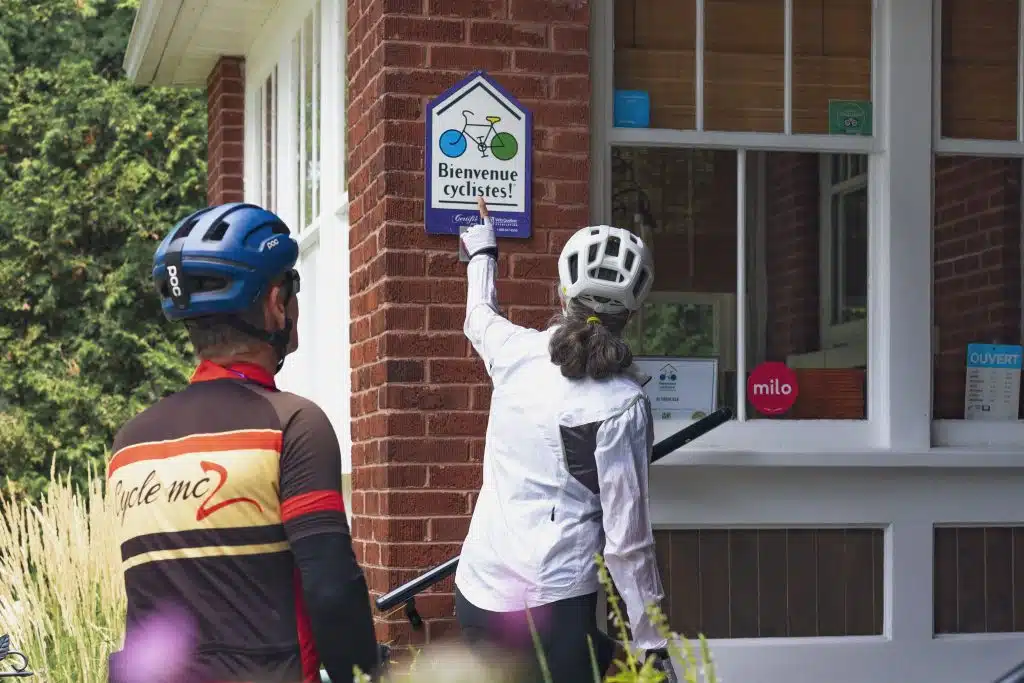
Cycling is still too often associated with large cities. This overlooks the fact that cycle tourism now generates more than $800 million in annual tourism spending and supports more than 6,500 jobs, both in major urban centers and in rural communities. The Bienvenue cyclistes! certification now covers 465 active businesses in 250 municipalities across Quebec—including lodging facilities, restaurants, and repair shops—and 67 % cycle tourists adjust their itineraries to prioritize businesses that have earned this certification.
It is a decentralized local economy that directly benefits the regions rather than just the major urban centers. It is hard to find a political party that does not, at one time or another, champion regional development.
For those who think about their children and parents
The trip from home to school alone would allow a child to achieve more than half of their recommended daily physical activity. Yet young people are increasingly turning away from walking and biking in favor of cars and school buses, particularly when they start high school—the very time when they would benefit most from staying active and developing their independence.
Many parents instinctively understand this sense of independence: being able to get around on one’s own, without relying on a parent to drive them or waiting for the bus, is a form of freedom we want for our children. The same logic applies at the other end of the life spectrum, for older adults who want to maintain their mobility for as long as possible. This isn’t a generational issue or a political one. It’s a family issue.
A conversation we can finally have in a different way
I’m not claiming that these four perspectives are enough to convince everyone of everything. But I believe they show that we can stop discussing cycling as a symbol and start discussing it as a matter of public policy—with its costs, benefits, and very real impacts—no matter which angle we approach it from.
The next government, whatever form it takes, will have its own agenda. I simply hope it will make room for cycling—not because it’s trendy, but because it’s, quite simply, a good idea.
- Jean-François Rheault, CEO of Vélo Québec

