















Counting

Vélo Québec would like to thank Eco Meter for its contribution to the Eco-Compteur scholarship program, We have also been involved in the development of a procedure and tools for manual counting, as well as in the automatic counting test carried out during the 2013 season.

Assessing development needs
Knowing the flow of cyclists on different sections of trail will help the manager determine which trails are more in need of maintenance, or even which ones need to be upgraded (for example, a very busy trail could indicate the need for another trail in the area, which would alleviate the flow by offering an alternative. Network design would thus be guided by concrete data).
Justifying investments
When a manager is looking for financing, the concept behind a project is an essential element, but it is often forgotten who the project is aimed at - in other words, the extent of the need. A high level of visitor numbers will justify the injection of greater sums into development and maintenance than a low level of visitor numbers. Similarly, count data, combined with data on the origin of users, can serve as a basis for calculating the economic benefits of a trail network.
Gain a better understanding of network usage
Since mountain biking has many different sub-categories, it's important to know whether the clientele is looking for more technical and steep trails (so-called old-fashioned) or smoother, undulating trails. By comparing the use of various types of trail, the manager will be able to better orient the profile of future constructions.
The various counting techniques have their advantages and disadvantages, and are often complementary.
Counting methods
Manual enumeration (counting)
Manual enumeration (counting) paints a picture of the practice at a given moment, similar to a photograph. Although inexpensive in terms of equipment, it is limited by the fact that a volunteer or employee must be present during a defined period, which also means that the data is limited to the counting period. Operating costs can be higher than those of an automatic counter, depending on the length of employment and remuneration of the person counting and compiling the data. Flexibility is gained, however, as the counter can be moved more easily to qualify several sections of trail.
Manual counting can also be useful for estimating total ridership on a particular branch or segment of a cycle network. Such an estimate is possible when there are automatic counters at other points on the network.
It is often used to validate data collected by automatic counting (in order to calibrate the counter), but can also be used to target elements that an automatic counter cannot observe:
- gender
- type of bike used (single or double suspension)
- user profile (rider, amateur, first contact)
- user skill level (e.g. for a technical element, to check whether it is suitable for users)
Tools for manual counting
Automatic counting
Automatic metering measures flow over a path on a continuous basis. The cost of installation and acquisition is higher than for manual metering, but the cost of operation is lower, often limited to a royalty if remote access is used (transmission and connection to a server) or to a few annual visits to check the integrity of the system and download data for a defined period.
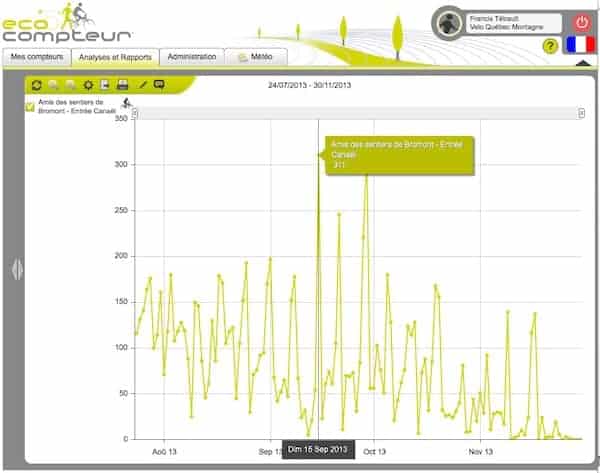
Automatic counting instruments not only record the total number of passages, but also the precise times and dates of each passage. Automatic counting therefore enables :
- observe daily and weekly traffic trends and identify the busiest days and times
- monitor traffic growth over the course of the season
- track changes in traffic over time, from year to year
By using two detection loops together, we can also observe the speed and direction of traffic.
Current instruments detect bike passages using an infrared sensor, a pneumatic tube or a magnetic loop. Data is then sent automatically by cellular network or downloaded periodically using a laptop computer. Meter manufacturers offer software or web portals to access the data and perform several types of analysis. In particular, they allow you to :
- generate graphs to visualize customer traffic
- compare the same period between several years
- compare traffic with weather conditions
Example of data collected with an automated meter
Find out more about trail counting
WEBINAR
Counting on the trails:
Collection and use of count data for mountain bike trails
Collection and use of count data for mountain bike trails
On the menu for this webinar presented on November 30, 2021 by Vélo Québec, Eco-Compteur and Parc régional de la Rivière Gentilly: presentation of the counting project carried out thanks to the Eco-Compteur 2021 grant at Parc régional de la Rivière Gentilly, its spin-offs and the use of the data.
All rights reserved 2026
Vélo Québec
Conception de sites web : PAR Design, Agence Web