














Lévis, Thursday, October 8, 2026 – In Lévis, cycling is part of daily life for most people. Cycling in Québec in 2025 highlights a practice that is widespread among the general population, one that is notable in particular for its gender-balanced nature.
Since 1995, Vélo Québec has published a report every five years The state of cycling in Quebec, a large-scale study that identifies key trends and provides insightful findings to guide decisions regarding the future of cycling in Quebec.
Unveiled last April, the 2025 edition of The state of cycling in Quebec ...highlighted, in particular, the growing role of bicycles as a genuine means of transportation throughout the province.
To highlight the specific realities of Quebec’s major urban centers, Vélo Québec also analyzed data collected from 8 of Quebec’s 10 largest cities: Gatineau, Trois-Rivières, Sherbrooke, Lévis, Saguenay, Laval, Québec City, and Montreal.
Today, Vélo Québec is unveiling The State of Cycling in Lévis in 2025, which provides insight into the habits of Lévis residents and trends in cycling in the city.
Major Trends in Cycling in Lévis in 2025
A majority of Lévis residents ride bicycles
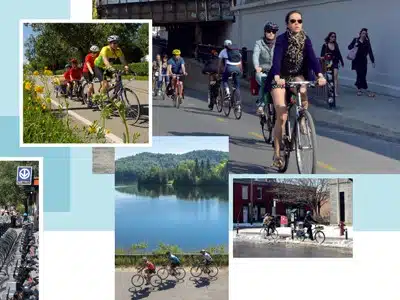
In Lévis, cycling is popular among a large portion of the population. In 2025, 83,000 residents rode bicycles, including 64,000 adults (56.% of the adult population) and 19,000 children (73.% of the child population).
Lévis thus stands out for its high proportion of adults who cycled in 2025, ranking second among the major Quebec cities studied. The city also stands out for its high proportion of older adults who cycle.
A bicycle network that encourages cycling
The high proportion of Lévis residents who bike is part of a broader context in which the city has a particularly extensive bike network. Lévis ranks among the major cities in Quebec with the largest cycling network relative to its road network, with 27 km of cycling paths per 100 km of road network.
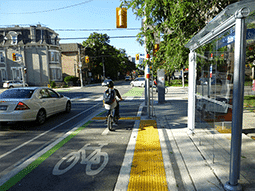
In 2025, Lévis’s bicycle network will span 351 km, including 110 km of bike lanes separated from motor vehicle traffic. These facilities, which provide a safe environment suitable for a wide range of cyclists, account for 31 % of the city’s bicycle network. The network also includes 171 km of bike lanes and paved shoulders, as well as 70 km of designated lanes.
Cycling Trends Toward Gender Parity
As in the rest of the province, cycling in Lévis is not yet equally popular among women and men. However, the gender balance is more even in Lévis than in other major cities in Quebec.
In 2025, men accounted for 53 % of cyclists in Lévis, compared with 47 % for women, making Lévis the Quebec city with the most gender-balanced cycling population. Across Quebec, men account for 59 % of cyclists, compared to 41 % for women.
A cycling culture supported by concrete actions
In Lévis, the development of cycling relies on the coordinated implementation of several measures and initiatives. In particular, the City has adopted a Bicycle Network Master Plan, updated in 2020, as well as a Lévis Road Safety Strategy adopted in 2024, which outlines several initiatives to promote cycling.
The City also relies on data to guide its decisions and evaluate the effectiveness of its initiatives. In particular, bicycle counters installed throughout the city make it possible to track trends in cycling. This first participation in *L’état du vélo* also helps to better document the habits of Lévis residents.
Combining cycling with other modes of transportation also helps expand travel options. In Lévis, all STLévis buses are equipped with bike racks. In 2025, more than 100,000 cyclists also used the ferries connecting Lévis to Québec City.
A rigorous approach to monitoring changes in practices
Produced by Vélo Québec every five years since 1995, The state of cycling in Quebec serves as the go-to source for data on cycling in the province.
The 2025 edition is based, in particular, on a population-based survey of 4,500 respondents—including 400 residents of Lévis—as well as on analyses conducted in collaboration with academic and institutional partners.
To view The State of Cycling in Quebec 2025 and its Lévis edition: www.velo.qc.ca/salle-de-presse/etat-du-velo/letat-du-velo-au-quebec-en-2025/
More data to come
The 2025 data for Gatineau, Trois-Rivières, and Saguenay have already been released. Data for the other major participating cities in Quebec—Laval, Sherbrooke, Quebec City, and Montreal—will be available in the coming weeks.
The State of Cycling in Quebec 2025 was made possible thanks to financial support from the Government of Quebec and the municipalities involved.
About Vélo Québec
Vélo Québec's mission is to develop a cycling culture for everyone, everywhere in Quebec. A national recreational organization recognized by the Quebec government, Vélo Québec promotes the use of bicycles for recreation, tourism and active transportation, in order to improve the health and well-being of the population, contribute to the economic vitality of our regions and meet our environmental challenges.
With its unique and original expertise, Vélo Québec is a benchmark in the planning, development and management of cycling infrastructures. Its know-how is put to good use in the municipal sector and among players involved in the transition to sustainable mobility.
In addition to its events, trips, publications and technical expertise, Vélo Québec coordinates education and mobilization programs, and oversees the deployment and standardization of Route verte.
Vélo Québec is also a key interlocutor with various levels of government to identify needs and solutions for improving and increasing bicycle use.
Information
Vélo Québec
Public relations and communications
514 942-0743


