HomeRoad Safety Based on Vision Zero and Safe Systems
Road Safety Based on Vision Zero and secure systems
Roads Designed to Prevent Serious Collisions
Quebec has made progress in road safety, but the most vulnerable people remain at particularly high risk: nearly 4 out of every 10 deaths involve pedestrians, cyclists, or motorcyclists.
To take this a step further, security must be integrated into the entire system: on our streets, in the vehicles that travel on them, and in the rules governing new modes of transportation.
Fully fund road safety and build safer streets and roads, both in cities and in rural areas.
4 - Promote safer vehicles
Take direct action to address the hazards posed by vehicles—particularly their weight, height, and blind spots—in order to better protect the most vulnerable road users.
5 - Clarify the rules governing electric bicycles
Clearly define what an electric-assist bicycle (EAB) is and distinguish it from other motorized micromobility vehicles in order to adopt rules tailored to the actual risks.
Recommendation #3
Develop a strategy Vision Zero: Fully Fund It and Create Environments That Support Active Mobility
Design our roads to prevent deaths and serious injuries.
The Approach Vision zero It is based on a simple principle: no death or serious injury on our roads should be considered inevitable.
Rather than relying solely on individual behavior for safety, we must also reduce risks at the source : build safe infrastructure, reduce speed limits, and better protect the most vulnerable people.
Vélo Québec proposes, among other things, to:
provide better funding for programs that enable municipalities and regions to make their streets and roads safer;
to do 30 km/h the default speed limit in urban areas where pedestrians, cyclists, and motor vehicles share the road;
strengthen the principle of prudence toward the most vulnerable users;
impose administrative penalties as of Blood alcohol content of 0.05;
specify the grounds for ineligibility for the failure to yield to pedestrians.
30 km/h = 90 %
the chances of survival for a pedestrian who has been struck.
À 50 km/h, they drop to just 20%.
Credit: Catherine Daoust (Rue Prieur, Montreal)
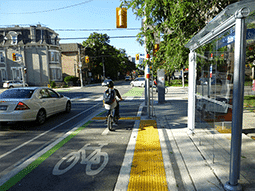
Credit: Catherine Daoust (Laval)
Credit: Catherine Daoust (Montreal)
Recommendation #4
Encourage the purchase of safe vehicles for all road users
Safety also depends on the vehicles we put on our roads.
Not all vehicles pose the same risk. Vehicles heavier, taller, or with large blind spots can have much more serious consequences in the event of a collision.
+44 %
This refers to the increased risk of death for a pedestrian or cyclist struck by an SUV rather than by a car.
Trucks, for example, account for less than 4 % of vehicles on the road, but are involved in nearly one-third of cyclist deaths and half of all pedestrian deaths.
Vélo Québec therefore proposes to better account for the danger posed by vehicles by:
using a risk index for heavy-duty vehicles;
encouraging the purchase of trucks that offer a better visibility and fewer blind spots;
adjusting registration fees based on the weight and danger level vehicles.
The goal: to manage risk at the source, rather than asking pedestrians and cyclists to bear sole responsibility for their own safety.
Recommendation #5
Adopt a definition electric bicycles for balanced and safe use of micromobility
Clear rules to distinguish electric bicycles from other motorized vehicles.
Visit electrically assisted bicycle (VAE) It allows people to travel longer distances and replace some car trips. However, its definition remains vague in Quebec, and it is often confused with other motorized vehicles.
900 000+
people used an e-bike in Quebec in 2025.
Vélo Québec is therefore proposing to create a clear definition of an e-bike, based in particular on its speed and power, and to distinguish it from electric scooters, self-balancing wheels, and other motorized devices that do not require pedaling.
This clarification would also make it possible to adapt certain rules to the reality of e-bikes, in particular:
lower the minimum age for Ages 18 to 14;
review the requirement for personal helmets for e-bikes in bike-sharing;
regulate these technologies by settlement, so that the rules can be more easily adapted as circumstances change;
promote VAE models the least risky and the most beneficial for mobility.
Credit: Francis Vachon (Dalhousie Street, Quebec City)
Credit: Lévy L. Marquis (Gatineau)
Discover our other pillars
Membership
Vélo Québec needs your help
By becoming a member of Vélo Québec, you support our mission to develop and promote cycling, and help us build the cycling Quebec of tomorrow.